
Written by  Maria Torres · Updated 2026-11-25
- Category
- Parks, Hills & Viewpoints
- Area
- Bellavista
Rising about 300 meters above the city, San Cristóbal is the centerpiece of the Parque Metropolitano, which spans more than 700 hectares across four municipalities and was created in 1966. The summit holds a 14-meter statue of the Immaculate Conception, where Pope John Paul II prayed on April 1, 1987. The funicular, inaugurated in 1925 and reopened in July 2022 after restoration, runs on about 500 meters of inclined track from Pío Nono in Bellavista to the summit. The cable car links the summit with the Tupahue and Oasis stations, near the Tupahue pool and Mapulemu botanical garden. Pick a clear day for Andes views, and allow half a day.
Quick facts
- Metro / train
- Metro de Santiago Line 1 · Baquedano
- Metro / train
- Metro de Santiago Line 5 · Baquedano
- Metro / train
- Metro de Santiago Line 1 · Pedro de Valdivia
- Height
- 880 m
Sources · facts checked on 2026-11-16
- San Cristóbal Hill (English Wikipedia)
- Cerro San Cristóbal (Chile) (Spanish Wikipedia)
- Santiago Metropolitan Park (English Wikipedia)
- Santiago Cable Car (English Wikipedia)
- Parque Metropolitano, MINVU
- Funicular centenary, MINVU (April 2025)
- Reopening of the funicular, MINVU (July 2022)
- Nuevo teleférico Parque Metropolitano, El Mercurio (Emol), February 2026
What San Cristóbal Hill is
Cerro San Cristóbal reaches 880 meters above sea level, about 300 meters above the surrounding city, and forms the core of the Parque Metropolitano de Santiago (Parquemet), the city's largest public park at more than 700 hectares. The park spreads across four municipalities, Huechuraba, Providencia, Recoleta and Vitacura, and its southern slopes come down directly into Bellavista (Barrio Bellavista), where the main entrance sits at the north end of Pío Nono street.
Before the Spanish arrived the hill was known as Tupahue; Pedro de Valdivia renamed it. Today it combines a Marian sanctuary on the summit, a 1925 funicular, two cable car lines, the National Zoo, two large summer swimming pools, botanical and Japanese gardens, an astronomical observatory and a network of roads and trails used heavily by walkers and cyclists. Parquemet receives about seven million visitors a year.
The summit: the Virgin and the sanctuary
The white statue of the Immaculate Conception that you see from much of Santiago stands 14 meters tall on an 8.3-meter pedestal and weighs about 36.6 tonnes. The Sanctuary of the Immaculate Conception was inaugurated on April 26, 1908, on the initiative of Archbishop Mariano Casanova and paid for by private donations. A chapel is set inside the pedestal, and below the statue an open-air amphitheater is used for Masses.
On April 1, 1987, Pope John Paul II prayed in the pedestal chapel and blessed the city from the summit; he rode up on the funicular, and a plaque recalls the trip. From the terraces around the statue the view runs east to the Andes and over the towers of Providencia and Las Condes, including the Gran Torre Costanera that houses Sky Costanera, and south over the flat grid of the center.
Getting up: funicular, cable cars or on foot
The funicular was inaugurated on April 25, 1925, under President Arturo Alessandri Palma, after former intendente Alberto Mackenna pushed for it in 1921. It runs on about 500 meters of inclined track from Pío Nono station in Bellavista to Cumbre station near the summit, with an intermediate stop at the zoo. The original Italian cars from Ceretti & Tanfani carried 50 people; today's car holds 40 and the trip takes 7 to 10 minutes. The machinery, in a machine room designed by architect Carlos de Landa, still runs on its original 1925 parts. The line was declared a Historic Monument in 2000 and reopened on July 22, 2022, after more than two years of restoration that brought new cars with glass roofs.
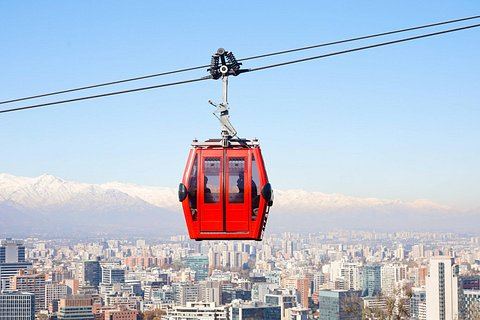
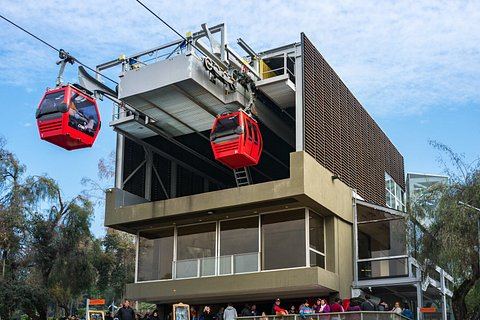
The original cable car (Teleférico) opened on April 1, 1980, closed in 2009 after a gearbox failure and reopened on November 24, 2016. It links Oasis station, on the Pedro de Valdivia side (Avenida El Cerro 750, Providencia), with Tupahue station and Cumbre station, where it meets the funicular. A second line, the Teleférico Pío Nono–Plaza México, opened on February 28, 2026: about 1 kilometer long, it climbs 180 meters from a lower station at the National Zoo to Plaza México near the summit in just over seven minutes, with 24 panoramic cabins and an intermediate station, Chile Nativo.
Walking up from Pío Nono takes about 45 minutes on the paved road and paths, with 300 meters of climbing; carry water in summer, and watch for cars and fast-moving cyclists on the roads.
Around the park: zoo, pools, gardens and observatory
The National Zoo (Zoológico Nacional) occupies the lower slope above Pío Nono and keeps animals of about 158 species; it was brought under the Metropolitan Park when the park was organized by law in 1966. Near Tupahue station are the Tupahue pool, opened in 1966 in a former quarry and 82 meters long, and the Mapulemu Botanical Garden. The Antilén pool, opened in 1976 on the top of Chacarillas hill, is 92 meters long. Both pools open only in summer, from November to March, and charge a separate entrance.
The Japanese Garden, designed by Tadashi Asahi, is reached from the cable car side, and the Chagual Botanical Garden is devoted to plants native to Chile. On the hill stands the Manuel Foster Observatory, built in 1903 as the Mills Observatory with funds from D. O. Mills as a twin of the Lick Observatory in California; its 37-inch telescope was the largest in the Southern Hemisphere at the time, and it now belongs to the Pontificia Universidad Católica de Chile.
How to get there
For the funicular and the Pío Nono cable car, take Metro de Santiago Line 1 or Line 5 to Baquedano, cross the Mapocho River and walk north along Pío Nono through Bellavista to the park gate. La Chascona, Pablo Neruda's house, is on a side street just off this route. For the Oasis–Tupahue–Cumbre cable car, take Line 1 to Pedro de Valdivia and walk north across the river to Avenida El Cerro. Several RED bus routes also stop near both entrances.
A good loop is to ride the funicular up from Bellavista, walk across the summit, and take the cable car down to Providencia, or the reverse. Tickets for the funicular and both cable car lines, singly or in combinations, are sold on telefericosantiago.cl.
Hours and practical tips
In 2025 the funicular ran Tuesday to Sunday from 10:00 to 18:45 and on Mondays from 13:00 to 18:45, closing on the first Monday of each month; the Pío Nono cable car opened with Tuesday-to-Sunday service and a Monday closure for maintenance. Fares differ between weekdays and weekends and between single rides and combined tickets, so check telefericosantiago.cl or parquemet.cl before you go.
Views of the Andes are sharpest on clear days after rain. Summer days are hot on the exposed summit, so carry water and sun protection. Allow half a day if you want to combine the summit with a cable car ride and one of the gardens or pools. At the top, Café Tudor at Cumbre station has windows into the funicular's machine room.
What to see on the hill
The main stops inside the Metropolitan Park, from the Bellavista side upward.
Funicular
Where Pío Nono to Cumbre
1925 funicular, Historic Monument, about 500 m of track with a stop at the zoo
National Zoo
Where Lower slope above Pío Nono
About 158 species; part of the Metropolitan Park since 1966
Sanctuary of the Immaculate Conception
Where Summit
14 m Virgin on an 8.3 m pedestal, inaugurated 1908, with a chapel and amphitheater
Teleférico Pío Nono–Plaza México
Where National Zoo to Plaza México
Cable car opened in 2026, about 1 km, just over 7 minutes
Teleférico (Oasis–Tupahue–Cumbre)
Where Avenida El Cerro 750 to the summit
Cable car opened 1980, reopened 2016
Tupahue pool and Mapulemu Botanical Garden
Where Tupahue station
82 m pool built in a former quarry in 1966, next to the botanical garden
Antilén pool
Where Top of Chacarillas hill
92 m pool opened in 1976
Japanese Garden
Where Cable car side of the park
Garden designed by Tadashi Asahi
Manuel Foster Observatory
Where On the hill
1903 observatory, once home to the largest telescope in the Southern Hemisphere
The pools open only from November to March; transport lines close for maintenance on some Mondays.
Frequently asked questions
How do I get to San Cristóbal Hill by Metro?
Take Line 1 or Line 5 to Baquedano and walk north along Pío Nono to the funicular, or take Line 1 to Pedro de Valdivia and walk to the cable car station on Avenida El Cerro.
Can you walk up San Cristóbal Hill?
Yes. From the Pío Nono entrance it is about a 45-minute walk with roughly 300 meters of climbing, on roads shared with cars and cyclists.
What are the funicular's opening hours?
In 2025 it ran Tuesday to Sunday 10:00 to 18:45 and Mondays 13:00 to 18:45, closed on the first Monday of each month. Check telefericosantiago.cl or parquemet.cl before you go.
How tall is the statue on San Cristóbal Hill?
The statue of the Immaculate Conception is 14 meters tall and stands on an 8.3-meter pedestal; it was inaugurated in 1908.
Is there a new cable car on San Cristóbal Hill?
Yes. The Teleférico Pío Nono–Plaza México opened on February 28, 2026, running about 1 kilometer from the National Zoo to near the summit in just over seven minutes.
How long do you need for San Cristóbal Hill?
Allow about half a day to ride up, enjoy the summit views and add a cable car ride or one of the gardens.
Popular tours that include San Cristóbal Hill & Metropolitan Park (Cerro San Cristóbal)
-
 Cable Car, Funicular and Sightseeing Bus in Santiago one day
Free cancellation
(opens in a new tab)
-
 Santiago : Hop-On Hop-Off, Cerro San Cristobal and Adventure
Free cancellation
(opens in a new tab)
-
 Discover Santiago: Tourist Bus, Cerro San Cristobal and Wine
Free cancellation
(opens in a new tab)
Affiliate link Viator · If you book through this link, we may earn a commission at no extra cost to you.
Affiliate link
Plan your trip
- Bike and scooter rentalBikesBooking (opens in a new tab)
If you book through this link, we may earn a commission at no extra cost to you.