
Written by  Maria Torres · Updated 2026-11-25
- Category
- Neighborhoods
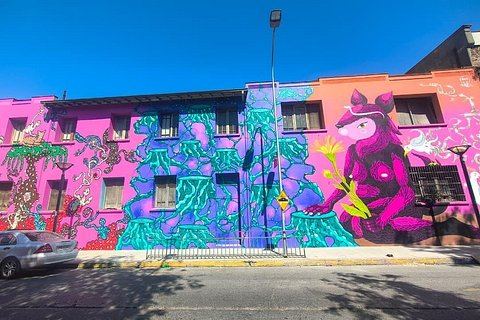
Barrio Yungay lies west of the city center, bounded by San Pablo, Ricardo Cumming, the Alameda and Matucana. The district was officially named in 1839 to celebrate the Chilean victory at the Battle of Yungay, and part of it was declared a Zona Típica national monument in 2009. Its heart is Plaza Yungay, with the Monumento al Roto Chileno honoring the ordinary Chilean, and the San Saturnino parish church nearby, both on land once inherited by the statesman Diego Portales. It remains a traditional residential neighborhood that has resisted much of the high-rise building seen elsewhere in the city. Quinta Normal park sits on its western edge, so the two combine easily.
Quick facts
- Metro / train
- Metro de Santiago Line 5 · Cumming
- Metro / train
- Metro de Santiago Line 5 · Quinta Normal
Sources · facts checked on 2026-11-16
- Barrio Yungay (Wikipedia es)
- Barrio Yungay (Wikipedia en)
- Plaza Yungay (Wikipedia es)
- Iglesia de San Saturnino (Wikipedia es)
- Ministry of Cultures: Zona Típica extension (April 2019)
- Museo de la Educación Gabriela Mistral (Wikipedia es)
- Biblioteca de Santiago (Wikipedia es)
- Line 5, Metro de Santiago (Wikipedia es)
Where Barrio Yungay is
Barrio Yungay is a traditional residential district in the northwest of the comuna of Santiago, bounded by San Pablo to the north, Ricardo Cumming to the east, the Alameda to the south and Avenida Matucana to the west. Barrio Brasil lies immediately to the east and Quinta Normal Park (Parque Quinta Normal) across Matucana to the west.
Its streets follow a regular grid that continues those of the old center; Catedral and Huérfanos were the first streets extended into it. The heart of the neighborhood is Plaza Yungay, a square of about 0.79 hectares bounded by Rafael Sotomayor, Rosas, Santo Domingo and Libertad streets.
History: the Portales lands and the Battle of Yungay
At the founding of Santiago in 1541, Pedro de Valdivia granted this land west of the city to Captain Diego García de Cáceres. By the early 19th century it belonged to José Santiago Portales y Larraín and was known as the llano de los Portales, an estate of some 350 hectares with orchards, mills and large houses on San Pablo street. After his death in 1836 his heirs began selling its 16 lots; the State bought the westernmost ones for what became Quinta Normal.
In 1837 the businessmen Juan de la Cruz Sotomayor and Jacinto Cueto bought the lot that had gone to Diego Portales, killed that same year. The subdivision set aside land for a square and the San Saturnino church, and a decree of President Joaquín Prieto on April 5, 1839, named the new district after the Battle of Yungay of January 20, 1839, the decisive victory in the war against the Peru-Bolivian Confederation. Early houses were single-story adobe with tile roofs and inner patios, in colonial style.
From 1870 well-off families moved in, along with scholars hired by the government, among them Ignacio Domeyko. From 1940 the upper classes began moving east to Providencia and beyond, and the neighborhood took in new residents. The 1985 earthquake damaged many old buildings, and by 1990 the population had fallen, prompting municipal plans for high-rise apartment blocks.
A neighborhood that defended itself
Residents formed a committee, led by the historian and neighbor Rosario Carvajal, to have the area protected. On February 19, 2009, a sector of about 113 hectares was declared a Zona Típica by Supreme Decree No. 43. After the earthquake of February 27, 2010, neighbors organized heritage emergency brigades with about 1,000 volunteers in the first hours; no building was totally demolished, and the campaign Yo restauro mi Barrio and the Fermín Vivaceta arts and crafts workshop school followed.
At residents' request, the protected area was extended on April 5, 2019, to about 230 hectares between Matucana, San Pablo, Manuel Rodríguez and the Alameda, consolidating Barrio Yungay, Barrio Brasil, Barrio Concha y Toro and the Lucrecia Valdés sector in one zone.
Plaza Yungay and San Saturnino
In the center of Plaza Yungay, on four columns rising from a fountain basin, stands the Monumento al Roto Chileno by the Chilean sculptor Virginio Arias. The 1.5-meter figure of a man of the people holds a rifle in his right hand, with a sheaf of wheat and a sickle behind him, and pays homage to the ordinary Chilean and to the victory at Yungay. Arias presented it at the Salon of French Artists in 1882 under the title Defensor de la Patria, where it received an honorable mention.
Beside the square is the Iglesia de San Saturnino, named for the patron saint of Santiago against earthquakes. Its construction was decreed in 1844 by Archbishop José Alejo Eyzaguirre, and the architect Teodoro Burchard completed it in 1887. The Gothic-style brick church has a central nave, two aisles and a bell tower over the choir, with wooden pillars and ceiling. Damaged in 1985 and again in 2010, it reopened in 2019 after restoration.
Museums and cultural spaces
The Museo de la Educación Gabriela Mistral, founded on September 13, 1941, occupies the west wing of the former Escuela Normal de Preceptoras, a teacher-training school at the corner of Chacabuco and Compañía de Jesús. The Biblioteca de Santiago, opened on November 11, 2005, at Matucana 151, is the country's largest public library; it fills a former state warehouse built between 1928 and 1945 and remodeled by the architects Cox y Ugarte, facing Parque Portales.
On the western edge, across Matucana, are the Museum of Memory and Human Rights (Museo de la Memoria y los Derechos Humanos) and Quinta Normal Park with its museums. Other landmarks of the neighborhood include the Museo de Arte Popular Americano Tomás Lago, the Museo del Sonido, Teatro Novedades, the Peluquería Francesa on Boulevard Lavaud and the cités Hurtado Rodríguez, Lucrecia Valdés de Barros and Adriana Cousiño. The district also appears in Chilean literature, notably Augusto d'Halmar's novel Juana Lucero (1902).
How to get there
Metro Line 5 crosses the neighborhood: Cumming station lies under Catedral street, and Quinta Normal station is on Matucana at the park entrance; both opened on March 31, 2004. Line 5 runs directly from Plaza de Armas, and from either station the grid of streets leads to Plaza Yungay.
Tips for your visit
Allow two hours for a walk around Plaza Yungay, San Saturnino and the cités, or a full day if you add the Museum of Memory and Human Rights and Quinta Normal Park. Barrio Brasil and Barrio Concha y Toro are next door to the east, so the three can be joined in one walk. This is a lived-in residential neighborhood rather than a nightlife zone; respect residents in the cités and passageways.
Key spots in Barrio Yungay
Landmarks within and on the edges of the neighborhood.
Plaza Yungay
Where Rafael Sotomayor, Rosas, Santo Domingo and Libertad
The district's central square, laid out in 1839
Monumento al Roto Chileno
Where Center of Plaza Yungay
Statue by Virginio Arias honoring the ordinary Chilean
Iglesia de San Saturnino
Where Beside Plaza Yungay
Gothic-style church completed in 1887 by Teodoro Burchard
Museo de la Educación Gabriela Mistral
Where Chacabuco and Compañía de Jesús
Education museum founded in 1941 in a former teacher-training school
Biblioteca de Santiago
Where Matucana 151
Chile's largest public library, opened 2005 in a 1928–1945 warehouse
Museum of Memory and Human Rights
Where Avenida Matucana
Museum on the 1973–1990 dictatorship, opposite Quinta Normal
Museum hours change; check each official site before you go.
Frequently asked questions
How do I get to Barrio Yungay?
Take Metro Line 5 to Cumming station, under Catedral street, or Quinta Normal station on Avenida Matucana, and walk to Plaza Yungay.
Why is it called Barrio Yungay?
A decree of April 5, 1839, named it after the Chilean victory at the Battle of Yungay on January 20, 1839, in the war against the Peru-Bolivian Confederation.
Is Barrio Yungay worth visiting?
Yes, for 19th-century streets and squares protected as a Zona Típica since 2009, the San Saturnino church, the Roto Chileno statue and nearby museums.
What is the Roto Chileno monument?
A statue by Virginio Arias in Plaza Yungay honoring the ordinary Chilean; it was first shown in Paris in 1882 as Defensor de la Patria.
What is near Barrio Yungay?
Quinta Normal Park and the Museum of Memory and Human Rights across Avenida Matucana, and Barrio Brasil and Barrio Concha y Toro to the east.
Popular tours that include Barrio Yungay
Affiliate link Viator · If you book through this link, we may earn a commission at no extra cost to you.