
Written by  Maria Torres · Updated 2026-11-25
- Category
- Historic Center
- Area
- Santiago Centro
Chile's seat of government began as the colonial mint: Joaquín Toesca designed it, construction started in the 1780s and the building opened in 1805, with coins struck here from 1814 to 1929. President Manuel Bulnes moved the government into the palace in 1845. On September 11, 1973, the air force bombed it during the military coup, and President Salvador Allende died inside; restoration finished in 1981. The long neoclassical facade faces the Plaza de la Constitución to the north, while the Plaza de la Ciudadanía lies to the south. Interior guided visits require advance online registration through the Presidency's heritage visits site, so check before you go; the La Moneda Cultural Center sits under the southern square.
Quick facts
- Address
- Moneda s/n, between Morandé and Teatinos, Santiago Centro
- Metro / train
- Metro de Santiago 1 · La Moneda (~2 min walk)
- Completed
- 1805
- Architect
- Joaquín Toesca
Sources · facts checked on 2026-11-16
- Visitas Patrimoniales, Presidencia de la República
- Meganoticias, how to visit La Moneda (2024)
- Emol, La Moneda pedestrian crossing (Sept 4, 2026)
- El Mostrador, Día de los Patrimonios 2026
- Palacio de La Moneda (Wikipedia es)
- La Moneda Palace (Wikipedia en)
- El Dínamo, Kast moves into La Moneda (March 2026)
- La Moneda Metro station (Wikipedia es)
What La Moneda is
La Moneda is the seat of the President of Chile and also houses the Ministry of the Interior, the General Secretariat of the Presidency and the General Secretariat of Government. The palace fills a whole block of the Civic District, bounded by Moneda street to the north, Morandé to the east, the Alameda (Avenida Libertador Bernardo O'Higgins) to the south and Teatinos to the west. Its main facade faces the Plaza de la Constitución; on the Alameda side lies the Plaza de la Ciudadanía.
The name means "the mint": the building was designed as the colonial Real Casa de Moneda, where coins were struck until the mint moved out in 1929.
From royal mint to presidential palace
The Italian architect Joaquín Toesca, a Roman-born pupil of Francesco Sabatini in Madrid, reached Santiago in early 1780 to work on the cathedral, and that June Governor Agustín de Jáuregui asked him to design a new mint. A first site near the Mapocho flooded when foundations were dug, so the works moved to the former Jesuit Colegio Carolino plot. Construction began in the mid-1780s with lime from the Polpaico estate, sand from the Maipo River, stone from a quarry on Cerro San Cristóbal, oak and cypress from the southern forests and ironwork from Vizcaya in Spain; the brick walls are more than a meter thick to withstand earthquakes.
Toesca died on June 11, 1799, before the building was finished, and the military engineer Agustín Cavallero continued it following his design. Governor Luis Muñoz de Guzmán inaugurated the Real Casa de Moneda in 1805. In 1845 President Manuel Bulnes made it the seat of government and presidential residence, and the move from the old Governors' Palace on the Plaza de Armas, where the Central Post Office (Correo Central) stands today, was completed in 1846.
Under President José Manuel Balmaceda (1886–1891) the palace was refurbished, the Presidency's courtyard was roofed with an iron structure and the Salón Rojo was decorated in white and gold. After the mint workshops left in 1929, the architect Josué Smith Solar added a south facade toward the Alameda in 1930, respecting Toesca's design. The small plaza that had stood in front of the palace since 1805 was cleared in 1935 to make way for today's Plaza de la Constitución.
September 11, 1973, and the restoration
During the military coup of September 11, 1973, the palace, where President Salvador Allende and some of his supporters were holding out, was shelled by army cannon and hit by rockets fired from two Hawker Hunter jets of the Chilean Air Force. Allende died inside that day. Fire spread from the corner of Moneda and Teatinos streets, and losses included the original 1818 Act of Independence and José Gil de Castro's portrait of Bernardo O'Higgins.
Restoration started that same month and ran until the end of 1980, while the government worked from the Edificio Diego Portales (today the Gabriela Mistral Cultural Center (GAM)). An underground complex, known as the bunker, was built under the Plaza de la Constitución, and the side door at Morandé 80, through which Allende's body was carried out, was sealed. President Ricardo Lagos reopened Morandé 80 in 2003, for the 30th anniversary of the coup, and in 2008 the room where Allende died was restored with its furniture and two paintings by Guillermo Muñoz Vera.
Inside: courtyards and salons
The entrance courtyard is the Patio de los Cañones, named for its colonial cannons. Beyond it, toward the Alameda, the Patio de los Naranjos (Courtyard of the Orange Trees), planted in the early 1980s, hosts the Presidency's large ceremonies; it has a 1671 water fountain that once stood in the Plaza de Armas and sculptures including Roberto Matta's Tolomirotodomiro, shown at the Chilean pavilion of Expo '92 in Seville.
The salons along Moneda street include the Salón Independencia, Salón Toesca and the Cabinet room, and the Galería de los Presidentes displays portraits and busts of past presidents. Since March 11, 2026, President José Antonio Kast has lived in the palace, the first president to do so since Carlos Ibáñez del Campo in the 1950s.
How to visit
Guided heritage visits inside the palace run year-round but require advance booking on the Presidency's Visitas Patrimoniales site, validating your details with a ClaveÚnica (Chile's state login) or with an email address; each booking must then be approved by email. As of November 2026 the official terms say every visitor from one year old must be registered, everyone aged 16 or over must show an ID card, passport or driver's license, and no bags, backpacks, luggage or food are allowed, since there are no lockers.
On some dates the Presidency also opens a pedestrian crossing through the courtyards, with separate registration; on September 4, 2026, for example, visitors walked through the Patio de los Cañones and Patio de los Naranjos. During the national heritage weekend (Día de los Patrimonios, held May 30–31 in 2026) the palace joins the program, also with prior registration.
Without a booking you can still see the north facade from the Plaza de la Constitución, where the Carabineros' Palace Guard holds the changing of the guard every other day, and walk around to the Plaza de la Ciudadanía on the Alameda.
Getting there and what is nearby
La Moneda station on Metro Line 1 has its exits on the Alameda right by the palace. Universidad de Chile station (Lines 1 and 3) is one stop east. From the Plaza de Armas you can walk south through the pedestrian streets of the center.
The La Moneda Cultural Center (Centro Cultural La Moneda), opened in January 2006, lies beneath the Plaza de la Ciudadanía and is the easiest place to combine with the palace. Barrio Concha y Toro lies farther west along the Alameda, near República station.
Frequently asked questions
Can you go inside La Moneda Palace?
Yes, on guided heritage visits booked in advance through the Presidency's Visitas Patrimoniales site. Every visitor needs a reservation, and those aged 16 and over must show an ID card, passport or driver's license.
When is the changing of the guard at La Moneda?
The Carabineros' Palace Guard changes every other day on the Plaza de la Constitución. Start times vary, so check locally before you go.
Can I bring a backpack on a La Moneda tour?
No. The official terms (November 2026) do not allow bags, backpacks, luggage or food, and there are no lockers.
What happened at La Moneda in 1973?
On September 11, 1973, during the military coup, the palace was shelled and bombed by Air Force jets; President Salvador Allende died inside. It was restored and reopened in March 1981.
Which Metro station is closest to La Moneda?
La Moneda station on Line 1, with exits on the Alameda beside the palace. Universidad de Chile (Lines 1 and 3) is also close.
Why is it called La Moneda?
It was built as the colonial mint (Casa de Moneda), designed by Joaquín Toesca and opened in 1805; coins were made there until 1929.
Popular tours that include La Moneda Palace (Palacio de La Moneda)
-
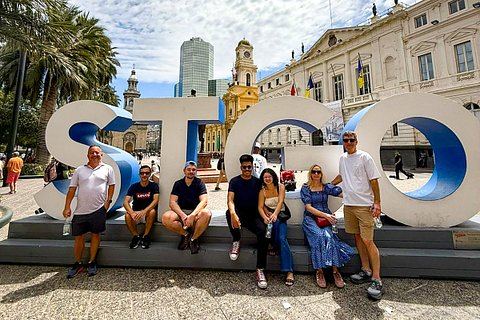 La Moneda Palace, Plaza de Armas & Historic Santiago Walking Tour
Free cancellation
(opens in a new tab)
-
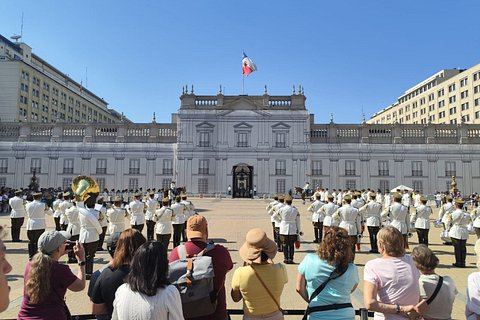 La Moneda Changing of Guard & Historic Santiago Walking Tour
Free cancellation
(opens in a new tab)
-
 A Fabulous Walking tour by the Old Santiago of Chile -
Free cancellation
(opens in a new tab)
Affiliate link Viator · If you book through this link, we may earn a commission at no extra cost to you.