
Written by  Maria Torres · Updated 2026-11-25
- Category
- Historic Center
- Area
- Santiago Centro
The seat of the Archbishop of Santiago fills the west side of the Plaza de Armas on a plot Pedro de Valdivia set aside in 1541. The present church is one of several on the site: its first stone was laid on July 1, 1748, after earthquakes wrecked earlier churches, and the Italian architect Joaquín Toesca arrived in Santiago in early 1780 and took over the works that year. The twin bell towers and final facade came with Ignacio Cremonesi's work, completed in 1906. Together with the Archbishop's Palace and Parroquia del Sagrario, the ensemble is protected as a national monument. Step inside for the nave of about 100 meters, then continue around the square to the Central Post Office.
Quick facts
- Address
- Plaza de Armas 444, Santiago Centro
- Metro / train
- Metro de Santiago 3 · Plaza de Armas (~2 min walk)
- Metro / train
- Metro de Santiago 5 · Plaza de Armas (~2 min walk)
- Architect
- Joaquín Toesca; Ignacio Cremonesi
What the cathedral is
The Metropolitan Cathedral is the seat of the Archbishop of Santiago and the principal Catholic church in Chile, dedicated to the Assumption of the Virgin Mary. It stands on the west side of the Plaza de Armas, at Plaza de Armas 444, with its apse on Bandera street. The ensemble includes three buildings: the cathedral itself, the Parroquia del Sagrario beside it and the Archbishop's Palace on the corner of Compañía street. The cathedral was declared a historic monument on July 6, 1951.
The church has three naves, a central one taller than the two side aisles. It is about 45 meters wide and about 100 meters long from the facade to the doors on Bandera street, covering roughly 4,500 square meters.
Earthquakes, a fire and four architects
On the day Santiago was founded, February 12, 1541, Pedro de Valdivia set aside the northwest corner of the square for a church. The first one, of adobe, faced north toward today's Catedral street. Pope Pius IV created the Diocese of Santiago in 1561. The earthquakes of 1647, 1657 and 1730 damaged or ruined successive churches, and in 1746 Bishop Juan González Melgarejo decided to build an entirely new, larger cathedral turned east to west, with its front on the square.
Plans by the Bavarian Jesuits Pedro Vogl and Juan Hagen were sent to Spain for approval in 1753, but work had already begun: the first stone was laid on July 1, 1748, at the Bandera street end so that the old church could stay in use. On the night of December 22, 1769, a fire destroyed the old cathedral, which sped up the new works; part of the new building opened for worship on December 8, 1775.
From 1780 the Italian architect Joaquín Toesca, newly arrived in Santiago, directed the works for about 20 years, imposed the neoclassical style and designed the facades of the cathedral and the Sagrario. Pope Gregory XVI raised Santiago to an archdiocese in 1840, making this the Metropolitan Cathedral. Between 1898 and 1906 Archbishop Mariano Casanova had the Italian architect Ignacio Cremonesi remodel the whole church: the stone was covered in stucco, the wooden coffered ceiling was replaced by a barrel vault with painted panels, the windows were enlarged for stained glass, and two bell towers were added to the facade. Casanova consecrated the remodeled cathedral on May 5, 1906.
What to see inside
At the end of the central nave stands the old high altar under a marble ciborium holding a crucifix made in Munich in 1912. Above it, the main altarpiece shows a carved wooden Assumption surrounded by angels and bronze rays, flanked by the apostle James, patron of the city, and Saint Rose of Lima. Next to the old altar is a choir organ built in 1754 by the German Jesuits of Calera de Tango, still in use. The large organ over the main door was made by Flight & Son of London; it has been silent since the 1980s.
The right aisle holds tombs of bishops and figures of Chile's history: a white marble neo-Gothic urn, inaugurated in 1912, with the hearts of the Chilean officers killed at the Battle of La Concepción in 1882; a carved wooden memorial to the Carrera brothers; and the bronze sarcophagus of Joaquín Larraín Gandarillas, founder of the Pontifical Catholic University of Chile. In the left aisle are the marble tomb of Archbishop Rafael Valentín Valdivieso and the Chapel of the Blessed Sacrament, where Pope John Paul II prayed on April 1, 1987, and Pope Francis on January 16, 2018. One of its altars has a polychrome wooden Christ that, by tradition, was a gift from King Philip II of Spain.
Under the presbytery lies the archbishops' crypt, remodeled in 2005 and 2006; during those excavations the remains of the minister Diego Portales, assassinated in 1837, were found. The Parroquia del Sagrario, entered through a door near the main entrance, keeps the crowned image of the Virgen del Carmen that is carried in procession at the end of September. On the ground floor of the Archbishop's Palace the Vicaría de la Solidaridad, the Church's human rights office, worked during the military dictatorship.
Restoration after the 2010 earthquake
The earthquake of February 27, 2010, damaged the building. A restoration that began in February 2014 and finished in July 2015 repaired the facade and ornaments, stabilized the structure with steel bars and carbon fiber reinforcement, renewed the lighting and built a new staircase to two lookouts in the bell towers.
Visiting: hours, Mass and audio guide
When this page was checked (November 2026), the cathedral's official site listed opening hours of Monday 10:00 to 14:30, Tuesday to Friday 9:30 to 18:00, Saturday 10:00 to 14:30 and Sunday 9:00 to 13:00, with Mass Monday to Saturday at 12:30 and Sunday at 9:45 and 12:00. Another page of the same site gave slightly different times, so check the official site or its social media before you go.
A free self-guided audio tour works through QR codes on information totems beside the altars, in Spanish, English and Portuguese; ask at the information point for a plan of the cathedral. The cathedral offers free wheelchairs and adapted access. Photos and video for personal use are allowed, but tripods need written permission, and guided tours inside may only be given by guides accredited by the cathedral chapter. Large luggage is not allowed, and visitors are asked to dress respectfully and keep quiet during services.
Getting there and nearby
Take Metro Line 3 or Line 5 to Plaza de Armas station, which opens onto the square next to the cathedral. The cathedral has no parking of its own.
Plan 30 to 45 minutes inside. On leaving, the Central Post Office (Correo Central) is next door on the north side of the square, the Chilean Museum of Pre-Columbian Art (Museo Chileno de Arte Precolombino) is a block west, and Casa Colorada is a block away on Merced street.
Frequently asked questions
What are the opening hours of Santiago's Metropolitan Cathedral?
In November 2026 the official site listed Monday 10:00–14:30, Tuesday to Friday 9:30–18:00, Saturday 10:00–14:30 and Sunday 9:00–13:00. Times can change, so check the official site before you go.
What time is Mass at Santiago Cathedral?
The official schedule (November 2026) lists Mass Monday to Saturday at 12:30 and Sunday at 9:45 and 12:00.
Who designed the Santiago Metropolitan Cathedral?
Plans by the Jesuits Pedro Vogl and Juan Hagen started the present building in 1748; Joaquín Toesca directed the works from 1780 and designed the neoclassical facades; Ignacio Cremonesi remodeled it between 1898 and 1906 and added the two towers.
Is there an audio guide in English?
Yes. A free self-guided audio tour in Spanish, English and Portuguese works through QR codes placed beside the altars.
Who is buried in Santiago Cathedral?
The crypt holds the bishops and archbishops of Santiago and the remains of Diego Portales; the aisles have tombs and memorials including Archbishop Valdivieso, Joaquín Larraín Gandarillas and the hearts of the officers killed at La Concepción in 1882.
How do I get to the cathedral by Metro?
Take Line 3 or Line 5 to Plaza de Armas station; the cathedral is on the west side of the square.
Popular tours that include Metropolitan Cathedral (Catedral Metropolitana)
-
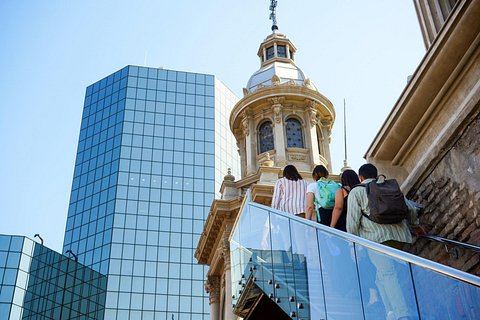 Official Tour of the Metropolitan Cathedral of Santiago
Free cancellation
(opens in a new tab)
-
 Santiago Half-Day Private City Tour Hotel Pick up & Food Sample
Free cancellationPrivate
(opens in a new tab)
-
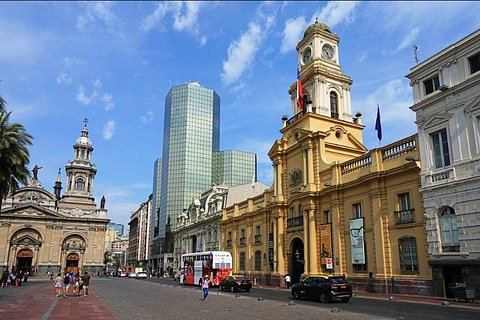 Santiago: Half-Day Sightseeing City Tour with Chauffeur and Guide
Free cancellationPrivate
(opens in a new tab)
Affiliate link Viator · If you book through this link, we may earn a commission at no extra cost to you.