
Written by  Maria Torres · Updated 2026-11-25
- Category
- Museums
- Area
- Santiago Centro
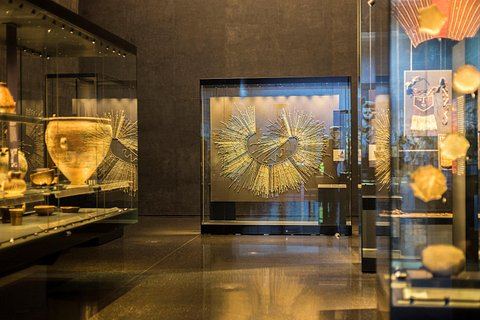
Founded in December 1981 around the collection of architect Sergio Larraín García-Moreno, this museum occupies the Palacio de la Real Aduana, the former royal customs house built between 1805 and 1807 a block west of the Plaza de Armas. Its galleries cover art from Mesoamerica, the Andes, the Amazon and the Caribbean, along with a strong section on peoples of present-day Chile. Highlights include Andean textiles more than 3,000 years old and Chinchorro mummies, among the oldest artificially mummified remains in the world. A 2014 expansion designed by Smiljan Radic added 70 percent more space. Allow about two hours.
Quick facts
- Address
- Bandera 361, corner of Compañía, Santiago Centro, 8320298
- Metro / train
- Metro de Santiago Line 5 · Plaza de Armas
- Metro / train
- Metro de Santiago Line 3 · Plaza de Armas
- Metro / train
- Metro de Santiago Line 1 · Universidad de Chile
- Opening hours
- Tue–Sun: 10:00–18:00
- Admission
- Paid (ticketed)
- Opened
- 1981
Sources · facts checked on 2026-11-16
What the museum is
The Museo Chileno de Arte Precolombino is a private non-profit foundation that opened on December 10, 1981, through a partnership between the Municipality of Santiago and the Fundación Familia Larraín Echenique. It occupies the Palacio de la Real Aduana, the former royal customs house on the corner of Bandera and Compañía streets, one block from the Plaza de Armas.
Its collection holds more than 10,000 pieces from Indigenous peoples across the Americas, of which only about 12 percent is on view in the permanent galleries. These are split into two exhibitions: América precolombina en el arte, which groups art by cultural area from Mexico to Argentina, and Chile antes de Chile, devoted to the peoples of present-day Chile. The museum also keeps a large audiovisual, photographic and sound archive, a library of more than 20,000 volumes on archaeology, anthropology and pre-Columbian art, and has published the scientific journal Boletín del Museo Chileno de Arte Precolombino since 1985.
América precolombina en el arte: the continental galleries
The upper galleries arrange showcases by cultural area: a Masterpieces (Obras Maestras) introduction, then Mesoamerica, the Caribbean, the Intermediate Area (eastern Nicaragua and Costa Rica, Panama, Venezuela, Colombia and Ecuador), the Amazon, the Central Andes (Peru and Bolivia), a Textile Room and the Southern Andes (Argentina and southern Peru and Bolivia).
Among the masterpieces is the lower half of Stela 6 from the Maya city of Aguateca in Guatemala, carved between 600 and 900 CE and 2.43 meters tall: a ruler dressed as a warrior, holding a dart and a shield bearing the Jaguar God of the Underworld, stands over two bound prisoners. An Aztec stone cult statue, 69 centimeters high, has a cavity in its chest where a stone heart was placed to receive divine power. A bronze bell of the Santa María culture of northern Argentina, made between 1200 and 1470 CE, was probably played in ceremonies, and stone figures from the highlands of southern Colombia represent shamans.
The Textile Room shows Andean textiles, most of them from the dry coasts of Peru and Chile, where the climate preserved cloth for millennia. When this page was checked in November 2026, the museum's site said the Textile Room and the Southern Andes room were temporarily closed, so check before you go if textiles are your reason to visit.
Chile antes de Chile and the Chinchorro mummies
Chile antes de Chile traces more than 14,000 years of human presence in the territory of present-day Chile, divided into geocultural zones: the Norte Grande, the Norte Chico, Chile under the Inka empire, the Central Zone, the South and Rapa Nui (Easter Island). The far south and its hunter-gatherer peoples are not covered, for lack of space and collections. The exhibition was designed with architect Smiljan Radic and museographer Geoffrey Pickup, and the collection of Manuel Santa Cruz and Hugo Yaconi, donated to the museum, forms part of it.
Its best-known objects are Chinchorro mummies from the far north, including those of infants and newborns. Chinchorro fishing people began mummifying their dead around 6000 BCE, almost three millennia before the practice appeared in Egypt, and stopped around 2000 BCE: they removed muscles and organs, replaced them with branches, feathers, leather, wool and other materials, covered the body in a layer of mud and gave the head a wig of human hair.
From Rapa Nui come carved wooden figures such as the moai kava kava, tangata and pa'a pa'a, which represent guardian spirits, demons and incarnations of animals and people. Other sections cover Mapuche textile art, silverwork and horse culture in the south.
Sergio Larraín García-Moreno and the founding
The museum began as the private collection of Chilean architect Sergio Larraín García-Moreno, who gathered pre-Columbian objects for about 50 years, choosing them for their aesthetic quality rather than for archaeological or ethnographic reasons. In the 1970s he looked for a way to keep the collection together; Santiago mayor Patricio Mekis backed the idea and searched for a building, while lawyer Julio Philippi drew up the legal structure, the Fundación Familia Larraín Echenique, through which Larraín's heirs donated the collection. Under an agreement with the municipality, which provided the building and general running costs, the museum opened in December 1981. Larraín died on June 27, 1999.
The Royal Customs House building
The site has a long history: in 1555 it was granted to Juan de Cuevas, Santiago's first corregidor, and from 1635 it held the Jesuits' Colegio Convictorio de San Francisco Javier. Governor Luis Muñoz de Guzmán then ordered the Palacio de la Real Aduana built here, and military engineer José María de Atero raised it between 1805 and 1807 in the neoclassical style, on plans by Joaquín Toesca, the Italian architect of La Moneda Palace (Palacio de La Moneda).
After independence the building housed the National Library, and from 1845 the law courts, until a large fire in 1968 destroyed the interior and its archives. It was rebuilt and restored in stages during the 1980s for the museum, and it is a national monument. In January 2014 a new phase designed by Smiljan Radic, funded through a partnership with Minera Escondida and BHP Billiton, enlarged the museum's area by 70 percent, adding exhibition space, storage and a conservation laboratory.
Tickets, hours and audio guide
When this page was checked (November 2026), the museum's official site listed opening hours of Tuesday to Sunday 10:00 to 18:00, with last admission at 17:15; it is closed on Mondays. Ticket prices were CLP 3,000 for Chilean nationals and residents, CLP 12,000 for foreign tourists, CLP 1,000 for university students and CLP 5,000 for foreign student tourists. Entry is free for children under 10, residents of the commune of Santiago, members of Indigenous peoples, and nationals and residents on the first Sunday of each month, among others; proof of eligibility is required. Tickets are sold at the reception desk or online. Check the official site before you go, as prices and hours can change.
A free digital guide with audio, produced with Bloomberg Connects, is available in Spanish, English and Portuguese through a QR code. The building has ramps, an elevator, a wheelchair and an adapted restroom, and there are bicycle racks, a café and an Artesanías de Chile craft shop.
Getting there and combining your visit
The entrance is at Bandera 361, on the corner of Compañía. The closest Metro de Santiago station is Plaza de Armas, where Lines 3 and 5 meet; Universidad de Chile station on Line 1 is the other option the museum lists. RED buses 504, 505, 508 and 514 run along Compañía street.
The museum is a short walk from the Plaza de Armas, the Metropolitan Cathedral (Catedral Metropolitana) and the Central Market (Mercado Central), so it fits easily into a morning in the historic center. Allow about two hours to see both permanent exhibitions.
Key pieces and galleries
Highlights of the two permanent exhibitions, as described by the museum.
Stela 6 of Aguateca
Where Masterpieces, América precolombina en el arte
Maya relief, 600 to 900 CE, 2.43 m tall: a warrior-ruler standing over two bound prisoners
Aztec cult statue
Where Masterpieces
Stone standing male figure, 69 cm, with a chest cavity that once held a stone heart
Santa María bronze bell
Where Masterpieces
Ceremonial bell from northern Argentina, 1200 to 1470 CE
Chinchorro mummies
Where Chile antes de Chile
Artificially mummified bodies from the far north, a practice begun around 6000 BCE
Rapa Nui wooden figures
Where Chile antes de Chile
Moai kava kava, tangata and pa'a pa'a carvings representing spirits
Textile Room
Where América precolombina en el arte
Andean textiles, mostly from the dry coasts of Peru and Chile
Some rooms close temporarily for maintenance or rotation; in November 2026 the Textile Room and Southern Andes room were closed.
Frequently asked questions
How much does the Pre-Columbian Art Museum in Santiago cost?
In November 2026 the official site listed CLP 12,000 for foreign tourists and CLP 3,000 for Chilean nationals and residents, with free entry for children under 10 and other groups. Check the official site before you go.
What are the opening hours of the Museo Precolombino?
Tuesday to Sunday from 10:00 to 18:00, with last admission at 17:15, as listed on the official site in November 2026; it is closed on Mondays.
Does the Pre-Columbian Art Museum have Chinchorro mummies?
Yes. Chinchorro mummies, including those of infants, are shown in the Chile antes de Chile exhibition.
Is there an English audio guide?
Yes. A free digital guide with audio in Spanish, English and Portuguese is available through Bloomberg Connects; scan the QR code at the museum.
How do I get to the Museo Chileno de Arte Precolombino?
Take the Metro to Plaza de Armas station (Lines 3 and 5) and walk one block to Bandera 361, on the corner of Compañía.
How long do you need at the Pre-Columbian Art Museum?
Plan on about two hours to see both permanent exhibitions.
Popular tours that include Chilean Museum of Pre-Columbian Art (Museo Chileno de Arte Precolombino)
-
 Museo Chileno de Arte Precolombino Admission Ticket
Free cancellation
(opens in a new tab)
-
 Santa Rita Vineyard Tour with Lunch An unforgettable experience!
Free cancellation
(opens in a new tab)
-
 Tour Viña Santa Rita: History, Wine and Picnic Outdoors
Free cancellation
(opens in a new tab)
Affiliate link Viator · If you book through this link, we may earn a commission at no extra cost to you.