
Written by  Maria Torres · Updated 2026-11-25
- Category
- Museums
Founded on September 18, 1880, as the National Museum of Paintings, this is considered the first art museum in Latin America. Since 1910 it has occupied the Palacio de Bellas Artes in Parque Forestal, designed by French-Chilean architect Émile Jéquier for the centennial and modeled on the Petit Palais in Paris. Its collection of more than 5,000 pieces holds Chile's leading selection of sculpture and covers Chilean art from the colonial period onward, plus Spanish, Flemish and Italian painting. The central hall under the glass roof is worth seeing in itself. The Museum of Contemporary Art occupies the western wing of the same building, so plan both together.
Quick facts
- Address
- José Miguel de la Barra 650, Lastarria & Bellas Artes
- Metro / train
- Metro de Santiago Line 5 · Bellas Artes
- Opening hours
- Tue–Sun: 10:00–18:30
- Admission
- Free
- Opened
- 1880
- Completed
- 1910
- Architect
- Emilio Jéquier
What the museum is
The Museo Nacional de Bellas Artes (MNBA) is Chile's national art museum, a public institution of the Servicio Nacional del Patrimonio Cultural. It was founded on September 18, 1880, as the Museo Nacional de Pinturas and is regarded as the first art museum in Latin America. Since 1910 it has occupied the Palacio de Bellas Artes, a Beaux-Arts palace on José Miguel de la Barra street in the middle of Forestal Park (Parque Forestal).
The collection covers Chilean and foreign art from the colonial period to the present and today numbers more than 5,000 pieces, including Chile's leading collection of sculpture. Displays of the collection and temporary exhibitions change through the year, so the works on view vary. The back half of the same building belongs to the University of Chile's Museum of Contemporary Art (Museo de Arte Contemporáneo), which has its own entrance.
From the Congress attic to the Palacio de Bellas Artes
In 1879 the sculptor José Miguel Blanco published an article in the Revista Chilena arguing that Chile needed a fine arts museum to gather works scattered across public buildings. With the support of Colonel Marcos Maturana, the government of President Aníbal Pinto set up a commission of Maturana, Blanco and the painter Juan Mochi, and the Museo Nacional de Pinturas opened on September 18, 1880, with 140 paintings by Chilean and foreign artists, shown in two rooms on the upper floor of the National Congress. Mochi was its first director.
In 1887 the museum moved to the Partenón in the Quinta Normal, an exhibition building put up by the Unión Artística society of Pedro Lira and Luis Dávila, and took the name Museo de Bellas Artes. In 1901 the government held a competition for a combined museum and fine arts school, and the channeling of the Mapocho River freed land on its bank that became Forestal Park. The Palacio de Bellas Artes opened on September 21, 1910, during the centennial celebrations, with an international exhibition of works from 14 countries.
The building was declared a national monument on December 30, 1976. It was reinforced after the 1985 earthquake, work that allowed it to come through the earthquake of February 2010 without significant damage and stay open. Entry has been free for everyone since March 3, 2015.
The building: Jéquier's palace and its glass dome
The palace was designed by the Chilean architect Emilio (Émile) Jéquier (1866 to 1949), born in Santiago to French parents and trained in Paris, who also designed the Palace of the Courts of Justice, the Stock Exchange building and Mapocho Station. Its facade and internal plan take their cue from the Petit Palais in Paris. Above the entrance, a high relief by Chilean sculptor Guillermo Córdova represents an allegory of the Fine Arts, and the exterior frieze carries 22 ceramic mosaic medallions portraying artists and architects such as Phidias, Praxiteles, Bramante, Viollet-le-Duc and Rembrandt. Art nouveau details in bronze leaves run along the entrance gates, stair railings and the cast-iron supports of the upper balconies.
The central hall is the building's showpiece: a glass dome made in Belgium by the Compagnie Centrale de Construction of Haine-Saint-Pierre and shipped to Chile in 1907, with a frame weighing about 115,000 kilograms and 2,400 panes of glass. Two caryatids by Antonio Coll y Pi appear to hold it up from the second-floor balconies, and a grand staircase on the central axis leads to the upper floor. Under the hall, the Sala Matta, named for Roberto Matta, was dug out in 1970 and 1971 under director Nemesio Antúnez, which meant lifting the whole floor slab of the hall.
In the small plaza at the entrance stands Rebeca Matte's sculpture Unidos en la gloria y en la muerte, showing Icarus and Daedalus. Her husband, Pedro Iñiguez, donated it in 1930, a year after her death; it is a copy of the monument the Chilean government gave to Brazil in 1922.
The collection: what to look for
Chilean art forms the core. Nineteenth-century academic painting includes foreign teachers such as Alejandro Ciccarelli and Juan Mochi, portraits by Pedro Lira and Manuel Thomson, and landscapes by Thomas Somerscales, Onofre Jarpa and Alberto Valenzuela Llanos. The 20th-century avant-gardes run from the cubist-influenced oils of Henriette Petit to Pablo Burchard, Camilo Mori, Nemesio Antúnez and Roberto Matta, and later artists such as Matilde Pérez and Rodolfo Opazo.
The international holdings lean toward Spain, France and Italy. The oldest pieces are 15th-century Annunciation panels from the workshop of Juan Rexach; Spanish painters include Francisco de Zurbarán, Bartolomé Esteban Murillo, Mariano Fortuny and Joaquín Sorolla. There are Flemish and Dutch Baroque paintings by artists such as Peter Paul Rubens and Jacob Jordaens, French landscapes by Camille Corot and Camille Pissarro, sculpture by Auguste Rodin and Antoine Bourdelle, and smaller groups of Japanese kakemono scrolls and prints and African sculpture.
Visiting: hours, entry and rules
When this page was checked (November 2026), the museum's official site gave opening hours of Tuesday to Sunday 10:00 to 18:30, with entry allowed until 18:20, and said admission is free for everyone with no reservation needed. It is closed on January 1, Good Friday, May 1, September 18 and 19 and December 25. Check the official site before you go.
Bags, backpacks and umbrellas are not allowed in the galleries, and lockers are provided. The rules also prohibit photo and video cameras in the exhibition rooms, so ask at reception before taking pictures. A single elevator serves the first and second floors; visitors with reduced mobility ask at reception and enter through the side door on Ismael Valdés Vergara street, and there is an accessible restroom on the first floor. Groups of 10 to 20 people can request a mediated tour at least 48 hours ahead by emailing [email protected].
Getting there and nearby
The museum is at José Miguel de la Barra 650, in Forestal Park. Bellas Artes station on Metro de Santiago Line 5 is the nearest, and buses run along Merced, Santo Domingo, Miraflores and Bellavista streets. There is a paid underground car park on José Miguel de la Barra between Monjitas and Merced.
Plan the Museum of Contemporary Art (Museo de Arte Contemporáneo) for the same visit, then walk through Forestal Park or into Barrio Lastarria, which borders it. The Central Market (Mercado Central) is a walk west along the park, and Bellavista (Barrio Bellavista) and La Chascona are across the Mapocho River.
What to look for in the Palacio de Bellas Artes
Building features and collection highlights. Collection works rotate, so not every painting is always on view.
Glass dome
Where Central hall
Belgian-made dome shipped in 1907, about 115,000 kg of framing and 2,400 panes
Caryatids
Where Second-floor balconies of the central hall
Two figures by Antonio Coll y Pi that appear to hold up the dome
Unidos en la gloria y en la muerte
Where Entrance plaza
Rebeca Matte's Icarus and Daedalus, donated in 1930
Facade medallions
Where Exterior frieze
22 ceramic mosaic portraits of artists and architects, from Phidias to Rembrandt
Sala Matta
Where Basement under the central hall
Exhibition room built in 1970 and 1971, named for Roberto Matta
Annunciation panels
Where Collection (Spanish art)
15th-century panels from the workshop of Juan Rexach, the oldest works in the collection
Collection displays and temporary exhibitions change; check the museum's program.
Frequently asked questions
Is the National Museum of Fine Arts in Santiago free?
Yes. Entry has been free for everyone since March 3, 2015, and no reservation is needed.
What are the opening hours of the Museo Nacional de Bellas Artes?
In November 2026 the official site listed Tuesday to Sunday 10:00 to 18:30, with entry until 18:20; it is closed on Mondays and some public holidays.
How do I get to the Fine Arts Museum?
Take Metro Line 5 to Bellas Artes station; the museum is at José Miguel de la Barra 650 in Forestal Park.
Can you take photos inside the Museo Nacional de Bellas Artes?
The museum's rules prohibit photo and video cameras in the exhibition rooms, so ask at reception before taking pictures.
Is the Museum of Contemporary Art in the same building?
Yes. The Museum of Contemporary Art occupies the back of the Palacio de Bellas Artes and has its own entrance.
Who designed the Palacio de Bellas Artes?
Chilean architect Emilio Jéquier, whose design takes its cue from the Petit Palais in Paris; it opened on September 21, 1910.
Popular tours that include National Museum of Fine Arts (Museo Nacional de Bellas Artes)
-
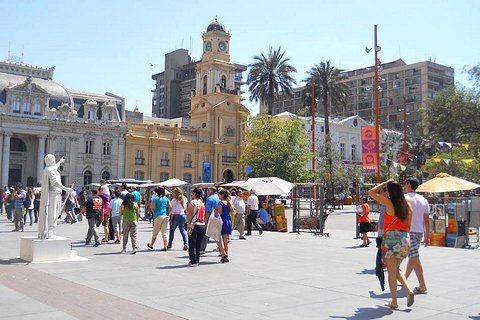 Private Tour: Half-Day Santiago Discovery
Private
(opens in a new tab)
-
 Best Santiago Street Food Tour with 4+ Tastings and Drink
Free cancellationPrivate
(opens in a new tab)
-
 Private Full-Day Bike Tour of Santiago Cultural 5-6 hrs
(opens in a new tab)
Affiliate link Viator · If you book through this link, we may earn a commission at no extra cost to you.