
Written by  Maria Torres · Updated 2026-11-25
- Category
- Wineries & the Andes
- Area
- Outside Santiago
Viña Santa Rita was founded in 1880 by Domingo Fernández Concha, and its main estate in Alto Jahuel, Buin, is about 44 km by road from Plaza de Armas. Its popular 120 label recalls the 120 patriots who, according to tradition, were sheltered here by Paula Jaraquemada after the defeat at Cancha Rayada during the wars of independence. The estate holds the Museo Andino, with pre-Hispanic and colonial objects, a small hotel called Casa Real and the Doña Paula restaurant. Vineyards stretch toward the hills behind the old buildings. Check the winery's site for current tours and plan a half day including the museum.
Quick facts
- Address
- Camino Padre Hurtado 0695, Alto Jahuel, Buin
- Metro / train
- EFE Tren Rancagua – Estación Central · Buin
- Distance from Santiago
- about 43 km by road
Official website → Open in OpenStreetMap →
Sources · facts checked on 2026-11-16
What Viña Santa Rita is
Viña Santa Rita is one of the historic wineries of the Maipo Valley. Its main estate lies in Alto Jahuel, in the municipality of Buin, about 43 km by road south of Plaza de Armas, and it is also the company's main production plant and distribution center. Besides the vineyards and cellars, the estate holds a protected 19th-century park, a small hotel called Casa Real, the Doña Paula restaurant and the Museo Andino, a free museum of Chilean archaeology and ethnography.
The company today grows grapes in the Maipo, Casablanca, Rapel, Lontué and Leyda valleys and sells its wines in more than 70 countries. It is controlled by the heirs of the businessman Ricardo Claro, whose group bought into the winery in 1980 and took full control in 1988.
History and the 120 patriots
Santa Rita was founded in 1880 by Domingo Fernández Concha. Within the estate stands the house that belonged to Paula Jaraquemada (1768–1851), a landowner remembered as a heroine of Chile's independence.
Tradition holds that after the patriot army's defeat at the battle of Cancha Rayada in 1818, Paula Jaraquemada sheltered 120 fleeing soldiers on her property, fed them, treated their wounds and gave them horses; when a royalist officer later demanded the keys to her cellar, she refused even at bayonet point. The winery's best-known everyday label, 120, takes its name from those 120 patriots, and the restaurant on the estate is named Doña Paula after her.
The park, the chapel and the cellars
The Park of Viña Santa Rita was declared a Historic Monument by Supreme Decree 2.017 of October 24, 1972. The protection covers about 40 hectares and explicitly includes the main house, the house that was Paula Jaraquemada's, the chapel and the cellars, bounded on the west by the Huidobro canal. In 2020 the Ministry of Cultures issued a further decree mapping the exact boundary of the protected area.
The park and the cellars are seen on the winery's guided tours, which are booked through santarita.com; the Museo Andino, inside the same estate, can be visited on its own without a tour.
Museo Andino
The Museo Andino was opened in January 2006 by the Fundación Claro Vial, set up in 2005 by Ricardo Claro Valdés, who donated the archaeological and ethnographic collections he and his wife María Luisa Vial had assembled. The museum holds more than 3,000 pieces from the peoples who have lived in what is now Chile.
The permanent exhibition, designed by José Pérez de Arce, fills two halls and travels through Chile from north to south. The first runs from the Arica region to central Chile, with extra rooms on Rapa Nui and on textiles and metalwork from across the Americas; the second covers Mapuche culture, the mixing of Indigenous and Spanish traditions, and ends with the horse-riding world of the Chilean countryside. All texts are in Spanish and English, written by specialists from the Chilean Museum of Pre-Columbian Art (Museo Chileno de Arte Precolombino), which makes a visit here a good follow-up to that museum in the center. A separate 210-square-meter hall hosts temporary exhibitions.
Admission is free and no booking is needed: when checked in November 2026 the museum was open Tuesday to Sunday from 10:30 to 17:00. Check before you go. Guided visits are offered only to schools and institutions that book ahead.
How to get there
The estate entrance and museum are at Camino Padre Hurtado 0695, Alto Jahuel, Buin. By car it is about 43 km from Plaza de Armas, roughly 45 minutes without traffic; search for "Viña Santa Rita" in your navigation app to reach the right gate.
Without a car, take the EFE train Tren Rancagua – Estación Central from Estación Central (Metro Line 1) to Buin station, or a bus to Buin. In Buin, shared taxis (colectivos) for the Buin–San Bernardo route leave from a stand on Avenida San Martín opposite the Tottus supermarket; tell the driver you are going to Viña Santa Rita and you will be dropped at the entrance. Alternatively, order a ride-hailing car from Buin to the Museo Andino.
If you plan to taste wine, do not drive: Chile has a zero-tolerance law on drinking and driving.
Tips for your visit
Book winery tours in advance through santarita.com, where the current tour list, languages, times and prices are published; the museum needs no reservation. Plan half a day for a tour plus the museum, and more if you add lunch at Doña Paula.
Santa Rita combines well with Concha y Toro Winery (Viña Concha y Toro) in Pirque, about 18 km away by road, for a full day in the Maipo Valley by car or with a driver. Museo Andino is closed on Mondays, so a Monday visit means tour only.
What to see at Santa Rita
The main parts of the Alto Jahuel estate.
Museo Andino
Access Free, Tuesday to Sunday (checked November 2026)
More than 3,000 archaeological and ethnographic pieces arranged from northern to southern Chile
Historic park
Access On guided tours
About 40 protected hectares with the main house, chapel and cellars, a Historic Monument since 1972
Paula Jaraquemada's house
Access Inside the protected park
The house linked to the 120 patriots sheltered after Cancha Rayada in 1818
Casa Real
Access Hotel on the estate
Small hotel in the estate's main house
Doña Paula
Access Restaurant on the estate
Restaurant named after Paula Jaraquemada
Tour options and prices change; check santarita.com before you go.
Frequently asked questions
How do I get to Viña Santa Rita by public transport?
Take the EFE Tren Rancagua – Estación Central to Buin, then a Buin–San Bernardo colectivo from Avenida San Martín opposite the Tottus supermarket, asking for Viña Santa Rita. A ride-hailing car from Buin is the alternative.
How far is Santa Rita winery from Santiago?
The estate in Alto Jahuel, Buin, is about 43 km by road from Plaza de Armas, roughly 45 minutes by car without traffic.
Is the Museo Andino free?
Yes. Admission is free and no booking is needed; in November 2026 it opened Tuesday to Sunday from 10:30 to 17:00. Check before you go.
Why is Santa Rita's wine called 120?
It recalls the 120 patriot soldiers whom, by tradition, Paula Jaraquemada sheltered on this property after the defeat at Cancha Rayada in 1818.
Do I need to book a tour at Santa Rita?
Yes, winery tours are booked in advance on santarita.com, where current options and prices are listed. The Museo Andino can be visited without a reservation.
Popular tours that include Santa Rita Winery (Viña Santa Rita)
-
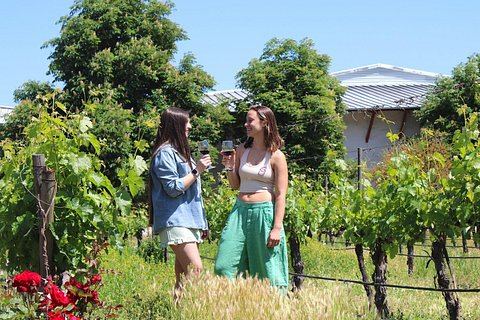 Santa Rita Vineyard Tour with Lunch An unforgettable experience!
Free cancellation
(opens in a new tab)
-
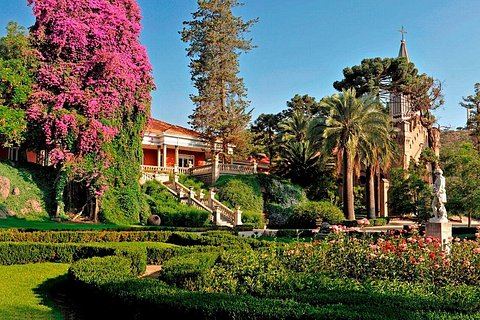 Santa Rita Winery Premium Tour
Free cancellation
(opens in a new tab)
-
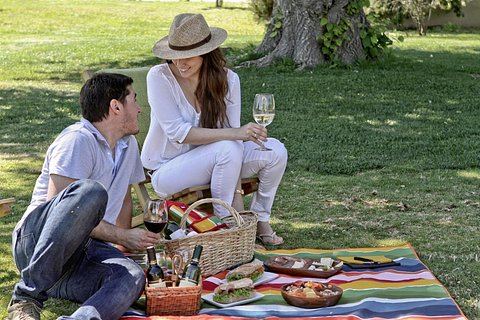 Tour Viña Santa Rita: History, Wine and Picnic Outdoors
Free cancellation
(opens in a new tab)
Affiliate link Viator · If you book through this link, we may earn a commission at no extra cost to you.
Affiliate link
Plan your trip
- Car rental in SantiagoQEEQ (opens in a new tab)
If you book through this link, we may earn a commission at no extra cost to you.