
Written by  Maria Torres · Updated 2026-11-25
- Category
- Day Trips from Santiago
- Area
- Outside Santiago
Viña del Mar, about 122 km by road from Plaza de Armas, was founded on December 28, 1874, by José Francisco Vergara and is known as the Garden City. Near Caleta Abarca beach, the Reloj de Flores is a working clock with numbers planted in flowers, and the neo-Tudor Castillo Wulff of 1906 stands on the shore nearby. The Fonck Museum displays pre-Columbian objects and a moai from Rapa Nui, and Quinta Vergara park hosts the city's international song festival. Long beaches and promenades run north toward Reñaca. It is easy to combine with Valparaíso on the same trip.
Quick facts
- Distance from Santiago
- about 122 km by road
What Viña del Mar is
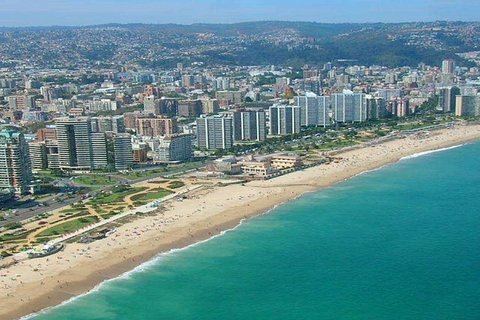
Viña del Mar is the resort city that adjoins Valparaíso on the same bay, about 122 km by road from Plaza de Armas. With 334,871 inhabitants in the 2024 census it is the most populous commune of the Valparaíso Region, and it is often called La Ciudad Jardín, the Garden City. Where Valparaíso climbs steep hills, Viña spreads over the flat plain at the mouth of the Marga Marga stream, with long beaches to the north, parks, mansions from the early 20th century and the casino.
The city has roughly 15 km of beaches. The busiest are El Sol, Acapulco and Caleta Abarca, and the Reñaca beaches farther north. In summer the city fills with visitors from Santiago, and every February the Quinta Vergara amphitheater hosts the Viña del Mar International Song Festival.
History: from a colonial vineyard to a planned city
The name means "vineyard of the sea". In 1580 Alonso de Riberos bought land in the Marga Marga basin and planted the first vines, which became known as the Viña de Riberos or Viña de la Mar. The modern town grew after the Santiago–Valparaíso railway arrived: its first stretch, 7 km from Barón station in Valparaíso to the Viña del Mar estate, opened on September 16, 1855, and wealthy families from Valparaíso began building along the tracks.
José Francisco Vergara, who had inherited the estate through his marriage to Mercedes Alvares, had engineers draw up a street plan, and the city was founded under its present name on December 28, 1874. The sugar refinery CRAV (1873) and the Lever, Murphy & Co. works (1883) gave it an industrial base. The Municipal Theater on Plaza Vergara was built between 1925 and 1930, and the casino opened on December 31, 1930, inaugurated by President Carlos Ibáñez del Campo.
The seafront: Reloj de Flores and Castillo Wulff
At the foot of Cerro Castillo, opposite Caleta Abarca beach, the Reloj de Flores is a working clock whose face is a flower bed. Its mechanism, made by the Favag factory in Neuchâtel, Switzerland, was bought in 1962, when Viña del Mar was one of the host cities of that year's World Cup. A GPS-controlled mechanism made in Mexico replaced the original in 2013.
A short walk away, on the shore between the mouth of the Marga Marga and Caleta Abarca at Avenida Marina 37, stands Castillo Wulff. The German-born businessman Gustavo Wulff, who came to Chile in 1881, needed a special law, granted in 1904, to build on the shoreline; the house went up in 1905 and 1906. In the late 1910s the architect Alberto Cruz Montt clad it in stone, and in 1920 a round tower linked to the house by a bridge in medieval style was added. The city bought it in 1959; it housed the Navy's naval and maritime museum until 1986, was declared a Historic Monument on September 20, 1995, and since 2005 has been the seat of the city's heritage office and an exhibition space.
Cerro Castillo above holds the presidential summer residence, built in 1930 under President Ibáñez, and Castillo Brunet, a castle-like house of 1923.
Fonck Museum and the moai
The Fonck Museum (Museo de Arqueología e Historia Francisco Fonck), at 4 Norte 784 on the corner of 1 Oriente, opened on November 25, 1937, and is named after Francisco Fonck, a German doctor and explorer who settled in Chile. Its collections cover the Rapa Nui (Easter Island) culture and the early peoples of northern, central and southern Chile, including the Atacameño, Mapuche and Diaguita cultures.
The moai at the entrance was brought from Easter Island in 1951 with the approval of the island's elders. Islanders moved it from Ahu One Makihi, where it lay toppled, to the jetty at Hanga Roa, and the Navy transport ship Presidente Pinto carried it to Valparaíso. It first stood on Avenida Marina in Viña del Mar and was moved to its present place beside the museum in 1988. It is one of the few moai outside the island.
In November 2026 the museum's own site listed these hours: Monday 10:00 a.m. to 2:00 p.m. and 3:00 to 6:00 p.m.; Tuesday to Saturday 10:00 a.m. to 6:00 p.m.; Sundays and holidays 10:00 a.m. to 2:00 p.m. Admission was CLP 4,500 for adults and CLP 1,000 for children aged 5 to 14, with free entry on the first Sunday of the month for holders of a Chilean ID card. It closes on January 1, Good Friday, May 1, September 18 and 19, and December 25. Check before you go.
Quinta Vergara and the palaces
Quinta Vergara, the city's best-known park, at Errázuriz 596, was the estate of the founder's family. After the 1906 earthquake destroyed their mansion, the family built the Palacio Vergara in 1910 in Venetian Gothic style. The city bought the palace and park in 1941; the building became the Museum of Fine Arts, whose collection started with about 60 European paintings owned by Blanca Vergara, and the park, planted in the 19th century with trees from Asia, Australia and California, opened to the public.
The park's amphitheater was built in 1963 to designs by the architect Hernando López after the success of the first Song Festival, held in February 1960. In 2002 the architect Borja Huidobro replaced its acoustic shell with a closed concrete amphitheater seating more than 15,000 people. Also in the park is Artequin Viña del Mar, opened in 2008, a museum of reproductions of Western artworks aimed at children and families.
In the center, Palacio Rioja was built from 1907 for the Spanish businessman Fernando Rioja Medel, who moved from Valparaíso after the 1906 earthquake, to designs by Alfredo Azancot; since 1979 it has housed the Museum of Decorative Arts.
How to get to Viña del Mar from Santiago
Intercity buses run from Santiago's terminals to Viña del Mar; Terminal Alameda, used by Turbus, Pullman Bus, Pullman Bus Costa Central and Cóndor among others, has an underground connection to Universidad de Santiago station on Metro Line 1. Check schedules on the operator's site. By car the route follows the Ruta 68 highway, about 122 km from Plaza de Armas.
Between Viña del Mar and Valparaíso, the Tren Limache-Puerto commuter train runs along the shore to Puerto station in Valparaíso's Barrio Puerto; through central Viña del Mar the line runs underground, a section built during the system's upgrade in the 2000s.
Tips for the day
A practical loop starts at the Reloj de Flores and Castillo Wulff on the seafront, continues to the Fonck Museum and Quinta Vergara in the center, and ends on the beaches toward Reñaca. Remember the Fonck Museum closes at 2:00 p.m. on Sundays.
Valparaíso is next door and the two are easily combined on one trip, while the Casablanca Valley (Valle de Casablanca) wineries lie on Ruta 68 on the way back to Santiago. Book well ahead if you plan to stay during the Song Festival in February, when the city is at its busiest.
What to see in Viña del Mar
The main sights, from the seafront to the city center.
Reloj de Flores
Where Foot of Cerro Castillo, opposite Caleta Abarca
Flower-bed clock with a Swiss mechanism bought in 1962
Castillo Wulff
Where Avenida Marina 37
Seafront house of 1905–1906, Historic Monument, exhibition space
Fonck Museum
Where 4 Norte 784
Archaeology and Rapa Nui collections, moai brought in 1951
Quinta Vergara
Where Errázuriz 596
Park with the 1910 Palacio Vergara and the festival amphitheater
Palacio Rioja
Where Calle Quillota
Mansion begun in 1907, Museum of Decorative Arts since 1979
Reñaca
Where North along the coast
Beaches, bars and clubs, busiest in summer
Museum hours and prices change; check the official sites before you go.
Frequently asked questions
How far is Viña del Mar from Santiago?
About 122 km by road from Plaza de Armas, via the Ruta 68 highway.
What is the Viña del Mar flower clock?
The Reloj de Flores is a working clock whose face is a flower bed, at the foot of Cerro Castillo opposite Caleta Abarca. Its Swiss mechanism was bought in 1962 for the World Cup.
What are the Fonck Museum opening hours?
In November 2026: Monday 10:00–14:00 and 15:00–18:00, Tuesday to Saturday 10:00–18:00, Sundays and holidays 10:00–14:00. Adults paid CLP 4,500; check before you go.
Is there a real moai in Viña del Mar?
Yes. The moai outside the Fonck Museum was brought from Ahu One Makihi on Easter Island in 1951 and has stood at the museum since 1988.
When is the Viña del Mar Song Festival?
It is held every February in the Quinta Vergara amphitheater, which seats more than 15,000 people. The first edition was in February 1960.
How do I get between Viña del Mar and Valparaíso?
The Tren Limache-Puerto commuter train links the two cities along the shore, ending at Puerto station in Valparaíso.
Popular tours that include Viña del Mar
-
 Valparaiso Port and Viña del Mar with Casablanca Wine Tasting
Free cancellation
(opens in a new tab)
-
 Tour to Valparaíso, Viña del Mar, Pablo Neruda Museum and Vineyard
Free cancellation
(opens in a new tab)
-
 Viña Del Mar-Valparaiso -Casablanca -Reñaca-Oceanic Rock-Concon
Free cancellation
(opens in a new tab)
Affiliate link Viator · If you book through this link, we may earn a commission at no extra cost to you.
Affiliate link
Plan your trip
- Private transfer from Santiago to Viña del MarKiwitaxi (opens in a new tab)GetTransfer (opens in a new tab)
- Car rental in SantiagoQEEQ (opens in a new tab)
If you book through this link, we may earn a commission at no extra cost to you.