
Written by  Maria Torres · Updated 2026-11-25
- Category
- Day Trips from Santiago
- Area
- Outside Santiago
Zapallar is a small, upscale beach resort in Petorca Province, about 166 km from Plaza de Armas, or roughly 2 hours by car. It was founded as a resort by Olegario Ovalle Vicuña, owner of the Catapilco hacienda, who gave lots to friends on condition that they build within two years; early residents planted woods, laid out the streets and built ramps down to the sea, and the commune was created in March 1916. Wooded headlands frame the sheltered main beach, and the 1924 Casa Hildesheim, decorated with carved wooden mythological figures, was declared a national monument in 1975. Neighboring Cachagua, within the same commune, faces the protected Isla de Cachagua; combine both in a long day.
What Zapallar is
Zapallar is a small beach resort and commune on the Pacific coast of Petorca Province, in the Valparaíso Region, about 167 km by road north-west of Plaza de Armas. The commune also includes Cachagua, La Laguna, Catapilco, El Blanquillo and La Hacienda; Zapallar and Cachagua are among Chile's most exclusive summer resorts, and the population roughly quadruples in summer. The name means "place of squashes".
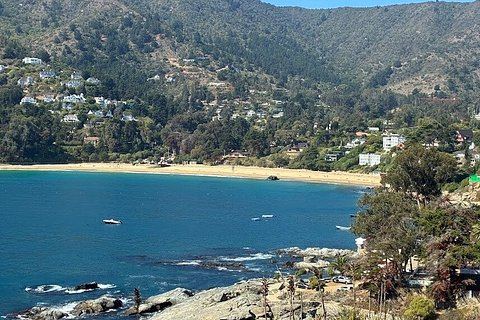
The town sits around a small bay framed by the hills La Higuera, El Morro and Cerro La Cruz, which shelter it from the coastal wind. The main beach has yellow sand and deep blue water, with a promenade linking it to the fishing cove (caleta) and its seafood restaurants, and dense woods climbing the slopes behind the houses. In 1989 the coastal strip between Mar Bravo and Isla Seca was declared a Zona Típica, a protected heritage area.
History of the resort
In 1599 the Arauco war veteran Francisco Hernández de Herrera took possession of the Catapilco hacienda, and the bay of Zapallar served as its landing place; it was declared a minor port in 1847, and the brothers Pablo and Romualdo Olmos founded the fishing cove in 1860. The resort itself dates from 1892, when the hacienda's owner, Olegario Ovalle Vicuña, gave the first lot to Manuel Valledor and Mercedes Sánchez. He laid out roads, squares and paths to the beach himself and gave lots to friends on condition that they build within two years; the early residents planted woods and built the ramps down to the sea.
The earthquake of August 16, 1906, destroyed or badly damaged most buildings and opened a second period of construction. Zapallar became a separate commune in March 1916, with Alejandro Fierro Carrera as first mayor, and in 1923 ten residents formed the Sociedad Balneario de Zapallar to pay for electric light, drinking water, streets and tree planting. Work on the Rambla, the seafront walk named after Fierro, began in 1930.
What to see in Zapallar
Walk the Rambla along the rocks from the beach to the caleta and on to Isla Seca, a large rock outcrop at the end of the bay. At the south end of the beach, the small peninsula of Cerro La Cruz is recognizable from afar by the single large tree on its top. Paseo Los Duendes, on calle Germán Riesco, is a stone-paved path through the trees, named after the goblins said to live there.
Casa Hildesheim, on Avenida Zapallar, was built in 1924 by the architect Josué Smith Solar for María Luisa Mac-Clure, widow of Agustín Edwards Ross, as a copy of a timber-framed guild house she had seen in Hildesheim, Germany; doors, windows and beams were made in Germany and shipped to Chile in 1923. Its outside walls are covered with carved wooden human figures and plant motifs, and it was declared a national monument in 1975. It is a private home, seen from the street. In the main square stands a bronze fountain basin cast in Chile in 1682, once owned by the Poor Clares, declared a historic monument in 1972.
North of town, Parque El Boldo protects 70 hectares of coastal sclerophyll forest, watered by sea fog, with rare trees such as the olivillo, naranjillo and belloto del norte. It is run by the Corporación Bosques de Zapallar, admission is paid, daily visitor numbers are capped, and you must book ahead; access is on foot only.
Cachagua and the penguin island
Cachagua lies 4 km south of Zapallar in the same commune, with a 5 km beach popular for walking and surfing. Facing it, about 100 meters offshore, is Isla Cachagua, a 4.5-hectare islet that was declared a nature sanctuary in 1979 and a natural monument on June 27, 1989. It is one of the five most important nesting sites in Chile of the Humboldt penguin, listed as vulnerable, and Magellanic penguins, Peruvian pelicans, cormorants and marine otters also live there.
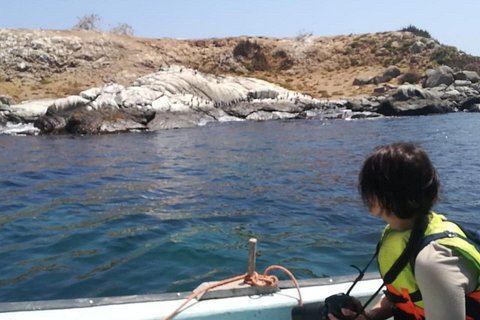
Landing on the island is not allowed. Watch it from Playa Los Coirones, which faces it, or take a fishing boat trip around it from the Zapallar caleta when the sea allows. Playa Las Cujas, reached by a footpath through the woods between Cachagua and Zapallar, has rock pools that are popular with families.
How to get to Zapallar from Santiago
By car the trip is about 167 km and a little over 2 hours in light traffic: take Route 5 Norte, turn off at Nogales onto route F-20 toward the coast, and follow coastal route F-30-E north through Maitencillo and Cachagua to Zapallar.
Without a car, check current bus services from Santiago to Zapallar with the operators before you go.
Tips for your visit
The water on this coast is cold, around 15 °C in summer at Cachagua, and some stretches of Cachagua beach have currents that make swimming unsafe; follow local signs and lifeguards. The coast is often cloudy, with fog and drizzle more frequent in winter.
A long day is enough for Zapallar's Rambla and beach, lunch at the caleta, and a stop at Cachagua to see the penguin island. Expect far more people in summer, when the commune's population roughly quadruples.
Key spots in Zapallar and Cachagua
Places to include in a day on this stretch of coast.
Rambla
Where Zapallar beach to Isla Seca
Seafront walk begun in 1930, past the caleta and rocks
Caleta de Zapallar
Where North side of the bay
Fishing cove with seafood restaurants; boat trips to Isla Cachagua
Cerro La Cruz
Where South end of Zapallar beach
Small headland topped by a single large tree
Casa Hildesheim
Where Avenida Zapallar
1924 copy of a German guild house with carved wooden figures; national monument
Parque El Boldo
Where North of Zapallar
70 ha of fog-fed native forest; paid, book ahead
Isla Cachagua
Where Off Playa Los Coirones, Cachagua
Natural monument with Humboldt and Magellanic penguins; no landing
Playa Las Cujas
Where Between Cachagua and Zapallar
Small beach with natural rock pools, reached on foot
Casa Hildesheim is private; Parque El Boldo requires advance booking.
Frequently asked questions
How far is Zapallar from Santiago?
About 167 km by road from Plaza de Armas, a little over 2 hours by car via Route 5 Norte, the F-20 at Nogales and the coastal F-30-E.
Can you see penguins near Zapallar?
Yes. Isla Cachagua, about 100 meters off Cachagua beach, is a nesting site for Humboldt and Magellanic penguins; you can watch from the shore or take a boat trip from the Zapallar caleta, but landing is not allowed.
Can you visit Casa Hildesheim in Zapallar?
Only from the outside. The 1924 house on Avenida Zapallar is a national monument but a private residence.
Is Zapallar worth a day trip from Santiago?
Yes if you want a quiet, wooded beach town with a seafront walk and the penguin island at Cachagua; it is a long day, with more than 4 hours of driving in total.
Is the water warm enough to swim in Zapallar?
The Pacific here is cold, around 15 °C in summer, and some parts of Cachagua beach have dangerous currents; swim only where it is marked as safe.
Popular tours that include Zapallar
-
 Zapallar : nature, sea and local flavours
Free cancellationPrivate
(opens in a new tab)
-
 Coastal Hike in Zapallar and Cachagua Nature and Gastronomy
Free cancellationPrivate
(opens in a new tab)
-
 Zapallar Private Beach Day Trip
Free cancellationPrivate
(opens in a new tab)
Affiliate link Viator · If you book through this link, we may earn a commission at no extra cost to you.