
Written by  Maria Torres · Updated 2026-11-25
- Category
- Day Trips from Santiago
- Area
- Outside Santiago
La Campana protects 8,000 hectares of Chile's coastal range between 400 and 2,222 meters and was created on October 17, 1967; with the Lago Peñuelas area it forms a UNESCO biosphere reserve. Its Palmar de Ocoa is one of the last natural forests of the endemic Chilean palm, and Charles Darwin climbed Cerro La Campana on August 17, 1834. The Ocoa entrance is off Ruta 5 Norte at km 98, about 112 km from Santiago, while the Granizo and Cajón Grande sectors are reached from Olmué. The Andinista trail to the summit is a demanding 7 km, about 8 hours, and its upper section closes from June to August. Only day visits are allowed; check CONAF and Pases Parques before you go.
What La Campana National Park protects
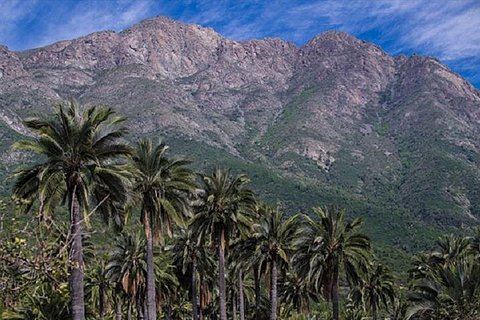
La Campana National Park covers 8,000 hectares of the Chilean coastal range in the Valparaíso Region, in the communes of Hijuelas and Olmué, between 400 and 2,222 meters above sea level. Its highest point is Cerro El Roble (2,222 m); the mountain that gives the park its name, Cerro La Campana (1,828 m), was called "the bell" because its outline from the Aconcagua valley looks like one. Together with the Lago Peñuelas reserve the park forms the La Campana-Peñuelas biosphere reserve recognized by UNESCO.
The climate is Mediterranean, with rain concentrated between May and August. The mix of sunny north-facing slopes, shaded south-facing ones and damp ravines lets the park hold about 545 species of vascular plants, among them plants usually found much farther north or south in Chile. The park is divided into three sectors, each in its own river basin and each with its own entrance: Granizo, Cajón Grande and Palmas de Ocoa.
The Palmar de Ocoa and other wildlife
The park's best-known sight is the Palmar de Ocoa, one of the last natural forests of the Chilean palm (Jubaea chilensis), a palm found only in Chile that can reach about 30 meters. Around 62,000 palms grow in the Ocoa sector; the densest stand, crossed by the El Amasijo trail, holds 113 palms per hectare. Because the trunks form no growth rings their age is hard to measure, but some are estimated to be up to 400 years old. Regeneration is slow, since degus and other rodents eat most of the hard little coconuts that fall between January and March.
Other trees include boldo, peumo, litre, quillay and the roble de Santiago (Nothofagus macrocarpa), whose groves cover the upper slopes of Cerro El Roble. Foxes, the degu and the lesser grison live here but are rarely seen; birds are easier to spot, including the black-chested buzzard-eagle, the Harris's hawk, the Chilean tinamou and the giant hummingbird, the largest hummingbird in the world.
History: from mines to national park
Archaeological finds such as mortars, grinding stones and piedras tacitas (cup-shaped hollows carved into boulders) show settlement by the Bato, Llolleo and Aconcagua cultures; the hollows near the palms may have been used to crack the palm nuts. After the Spanish conquest the area was searched for gold from around 1560, and copper mining later became industrial: the Compañía Minera e Industrial La Campana, founded in 1920, owned 26 mines on the mountain. The remains of the Pronosticada mine, known simply as "la mina", lie on the summit trail. The last mining in the park ended only in 1994.
On August 17, 1834, Charles Darwin reached the summit of Cerro La Campana during the voyage of HMS Beagle, after two days on horseback and on foot; a plaque near the top, above the mine, recalls his climb. Botanists asked for protection of the Ocoa palms from 1936, and a campaign led from 1964 by the Limache botanist Agustín Garaventa and Álvaro Valenzuela of the Sociedad Científica de Valparaíso led to Law 16,699, which created the park on October 17, 1967. Its present boundaries were fixed by decree in 1985.
Trails and what to choose
The classic hike is the Sendero Andinista from the Granizo sector to the summit of Cerro La Campana: 7 km, about 8 hours in total and rated demanding, with risks that include extreme temperatures, snowfall, strong winds, lightning and rockfall. From June to August the section from the mine to the summit is closed, and entering it is fined under a municipal ordinance. On a clear day the summit looks over the Aconcagua basin from the Andes to the Pacific.
In the Ocoa sector the El Amasijo trail (7 km, 7 hours, demanding) climbs through the palm forest toward the Portezuelo de Ocoa, and the Portezuelo de Ocoa trail is 5.2 km and about 6 hours. Shorter options include La Canasta in Granizo (1 km, 1 hour, with labeled plants), Mina Nueva (1 km, 90 minutes), Los Peumos (2.5 km, 3 hours) and the El Arenal-El Coipo circuit (2 km, 1 hour). Times are the park's own figures; plan to be back at your car well before dark.
Only day visits are allowed: the camping areas are closed and fires, gas stoves and smoking are banned, as are pets and drones. Cycling is allowed only on the vehicle roads of Granizo and Palmas de Ocoa.
How to get to La Campana from Santiago
The Ocoa entrance (palms and the La Cortadera waterfall) is the closest to Santiago, about 112 km away: drive north on Route 5 Norte and leave it at km 98 for the village of Ocoa, in Hijuelas, then follow the road to the end of calle Vista Hermosa and the park gate.
The Granizo entrance (summit trail) is at paradero 45 of Avenida Granizo in Olmué, and Cajón Grande at paradero 40. From Santiago the direct route leaves Route 5 Norte at Polpaico for Tiltil and crosses the Cuesta La Dormida pass to Olmué, about 100 km in all; the pass is a winding mountain road. Without a car, take the Valparaíso Metro train to Limache and a local bus toward Granizo.
Tips for your visit
Entry is managed through CONAF's Pases Parques system, which publishes the current opening hours, rules and tickets; check it before you go and book there. Spring (September to November) brings flowering orchids and shrubs and the summit trail is open; summer days get hot on the exposed north-facing slopes, so start early and carry plenty of water. Wear hiking boots, as the park asks.
La Campana is one of the mountains with the most fatal accidents in Chile, so stay on the marked trails; the climbing routes on the faces of Cerro La Campana are for trained, equipped mountaineers only. A visit combines easily with a stop in Olmué, or with Valparaíso and Viña del Mar on the coast.
Park sectors at a glance
The three sectors have separate entrances and are not linked by road inside the park.
Granizo
Entrance Avenida Granizo paradero 45, Olmué
Sendero Andinista to the summit, the Pronosticada mine, Darwin plaque, La Canasta plant trail
Cajón Grande
Entrance Avenida Granizo paradero 40, Olmué
Roble forests, Los Robles trail and the Poza del Coipo
Palmas de Ocoa
Entrance Route 5 Norte km 98, Hijuelas
Chilean palm forest, El Amasijo trail, Salto La Cortadera waterfall
Trail lengths and times as published by CONAF; check Pases Parques for current hours and closures.
Frequently asked questions
How far is La Campana National Park from Santiago?
The Ocoa entrance is about 112 km north-west of Santiago via Route 5 Norte; the Granizo entrance in Olmué is about 100 km away via Tiltil and the Cuesta La Dormida.
How long does it take to climb Cerro La Campana?
The Sendero Andinista is 7 km and takes about 8 hours in total; it is rated demanding, and its upper section from the mine to the summit is closed from June to August.
Can you camp in La Campana National Park?
No. The camping areas are currently closed and only day visits are allowed; fires and gas stoves are banned.
Where are the Chilean palms in La Campana?
In the Palmas de Ocoa sector, entered from Route 5 Norte at km 98, where around 62,000 Chilean palms grow along trails such as El Amasijo.
Do I need a ticket for La Campana?
Yes. Tickets, opening hours and current conditions are on CONAF's Pases Parques site; check it before you go.
Did Charles Darwin climb Cerro La Campana?
Yes, on August 17, 1834, during the voyage of HMS Beagle; a plaque near the summit marks his ascent.
Popular tours that include La Campana National Park (Parque Nacional La Campana)
Affiliate link Viator · If you book through this link, we may earn a commission at no extra cost to you.