
Written by  Maria Torres · Updated 2026-11-25
- Category
- Day Trips from Santiago
- Area
- Outside Santiago
Quintay is a fishing cove in the commune of Casablanca, about 125 km from Plaza de Armas, or a little under 2 hours by car. Fishermen from Algarrobo, El Quisco and Valparaíso settled the caleta around 1900, and from 1943 to 1967 it hosted Chile's largest whaling station, run by the INDUS company and able to process 16 whales a day. The station's sheds, slipway and pier were declared a national monument in 2015, and the Fundación Quintay runs a museum there on the plant's history and on whales, while Universidad Andrés Bello operates a marine research center on site. Allow time for the museum and a walk around the cove, and pair it with the Casablanca Valley of this guide, which lies on the way.
What Quintay is
Quintay is a fishing cove (caleta) and small village in the commune of Casablanca, in the Valparaíso Region, about 125 km by road from Plaza de Armas and 44 km south of Valparaíso. Its draw is unique in Chile: the former Quintay whaling station, the largest the country ever had, now a historic monument and site museum on the edge of the bay.
The cove is sheltered from the prevailing southerly winds by Cerro Curauma, whose cliffs drop straight into the sea at the north end of Playa Grande, a white-sand beach of roughly a kilometer backed by pines and peumo trees. The fishermen's houses, the village and the newer holiday homes sit on terraces cut into the steep hillsides above the caleta, and the fishermen run seafood restaurants along the waterfront.
History of the whaling station
Fishermen from Algarrobo, El Quisco and Valparaíso settled the caleta around 1900. The whaling plant was built by the INDUS company and opened in 1943 on land reclaimed between the rocky islets of the bay, a job for which miners were brought down from the Andes. Between 700 and 1,000 people worked there in shifts all year, and up to eight catcher boats armed with cannon-fired harpoons could bring in 16 whales a day. The plant produced oil, tallow, soap, combs, meat and other goods for the Chilean market.
Full-scale operation for the domestic market ended in the early 1960s. From 1964 INDUS worked with a Japanese company, Nitto Hogei, which brought modern catcher boats and a refrigerated ship to produce whale meat for Japan. The last season, from January to March 1967, took 486 whales, and the plant then closed because it was no longer profitable. Abandoned and stripped, the buildings fell into ruin until 1997, when Quintay residents created the Fundación Quintay to rescue them; the government granted the foundation part of the site in 1999, and Universidad Andrés Bello runs a marine research center in other former plant buildings. The station was declared a historic monument on August 10, 2015.
Inside the whaling station museum
The visit starts on the open esplanades, about 9,500 m² in all, and the 85 m² pier with the ramp up which the whales were hauled; photo panels show what happened on each platform. Five restored buildings house the exhibition rooms. Room 1, "Myths and realities", covers whales in myth, prayer and literature, including lines by Pablo Neruda on the abandoned station. Room 2 shows photos taken between 1953 and 1955 by Luis Pita Sanclaudio, the plant's personnel manager, a model of the whaler INDUS 7 that sank in the bay, and a film of a whale hunt shot by the company in 1958.
Room 3, rebuilt from ruins in 2018, holds "Cetáceos: de la tierra al mar", an exhibition created by the National Museum of Natural History that traces the evolution of whales through 17 original pieces and replicas, including a series of skulls. Room 4 is a semi-underground screening room, and Room 5 deals with marine protection, including Chile's marine parks and the management areas first tested with the repopulation of the loco (Chilean abalone) in Quintay bay.
The cove, beaches and diving
Beyond the museum, walk around the caleta to watch the boats come in, then climb to the village or head to Playa Grande on the north side of the bay. The southern shore is steep and rocky, with a small beach.
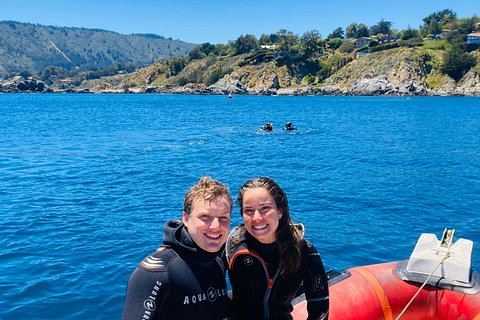
Quintay is a popular dive site, with dive schools operating in summer. Sites in the bay include the wreck known as El Falucho, a 25-meter boat of the INDUS fleet resting at 15 meters on white sand, and La Caldera, the boiler of the whaler Indus IV at about 8 meters, suited to beginners; old harpoons and anchors still lie on the seabed at other sites.
How to get to Quintay from Santiago
By car the trip is about 125 km and under 2 hours: take Route 68, the toll highway from Santiago to Valparaíso, as far as the Casablanca area, then turn off onto route F-800 for the coast and Quintay. Route 68 crosses the vineyards of the Casablanca Valley (Valle de Casablanca), so wineries and Quintay combine well in one day.
Without a car, check current bus connections via Valparaíso or Casablanca before you go.
Tips for your visit
Allow about an hour for the museum and esplanades and another for the cove and beach. The museum's opening days and admission are not published online in detail, so contact the Fundación Quintay before you go, especially outside summer.
Quintay also pairs with Isla Negra (Casa Museo Isla Negra), Neruda's house farther south on the same coast.
What to see in Quintay
The main stops in and around the cove.
Esplanades and pier
Where Former whaling station
9,500 m² of platforms and the ramp where whales were hauled up
Room 2
Where Former whaling station
1950s photos by Luis Pita Sanclaudio, INDUS 7 model, 1958 hunt film
Room 3
Where Former whaling station
Whale evolution exhibition with 17 pieces and skulls
Caleta
Where Below the village
Fishing cove with boats and seafood restaurants
Playa Grande
Where North side of the bay
White-sand beach below Cerro Curauma
El Falucho
Where Quintay bay, 15 m deep
Wreck of an INDUS fleet boat, a popular dive
Restaurants and dive schools are private businesses; contact them directly for current schedules.
Frequently asked questions
How far is Quintay from Santiago?
About 125 km by road from Plaza de Armas, under 2 hours by car via Route 68 and route F-800.
What is there to see in Quintay?
The former whaling station, which ran from 1943 to 1967 and is now a museum with five exhibition rooms, plus the fishing cove, Playa Grande and dive sites in the bay.
When did the Quintay whaling station close?
In 1967, after a final season from January to March in which 486 whales were taken; the plant had become unprofitable.
Can you combine Quintay with the Casablanca Valley?
Yes. Route 68 from Santiago passes through the Casablanca Valley wine area, where you turn off for Quintay.
Can you dive in Quintay?
Yes. The bay has dive schools in summer and sites such as the El Falucho wreck at 15 meters and the Indus IV boiler at about 8 meters.
Popular tours that include Quintay
Affiliate link Viator · If you book through this link, we may earn a commission at no extra cost to you.