
Written by  Maria Torres · Updated 2026-11-25
- Category
- Day Trips from Santiago
- Area
- Outside Santiago
Pomaire is a small potters' village in the commune of Melipilla, about 69 km by road from Plaza de Armas, home to about 3,900 people in the 2017 census. Local history traces the settlement to Inca and Diaguita groups who arrived in 1482, and its clay tradition predates the Spanish. Black pieces get their color from smoke, and kilns fire the clay at 600 to 800 °C. Workshops along Roberto Bravo street sell reddish, smooth-glazed greda pots, pans and the three-legged clay piggy banks said to bring luck. Restaurants serve Chilean classics such as pastel de choclo and empanadas. Allow a half day and bring cash for small purchases.
Quick facts
- Distance from Santiago
- about 69 km by road
Sources · facts checked on 2026-11-16
What Pomaire is
Pomaire is a small village of potters in the commune of Melipilla, in the Santiago Metropolitan Region, about 69 km by road south-west of Plaza de Armas. It had 3,921 inhabitants in the 2017 census. The village lives from greda, the local clay dug from the hills that surround it, and from the restaurants that feed day visitors from the capital.
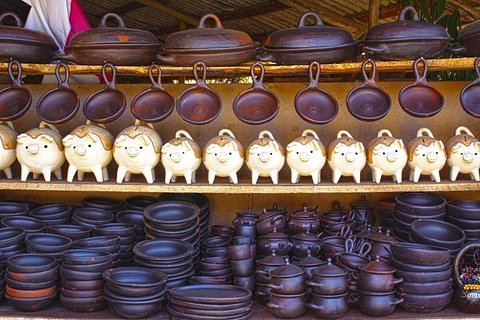
The workshops and shops line the main streets, above all Roberto Bravo, where pots, casseroles (pailas), bowls and decorative pieces are stacked on tables and shelves outside the doors. Local pottery is reddish with a smooth, shiny surface; glazed pieces are also sold today. The black pieces are colored with smoke from burning horse or cow dung, and the smell disappears in the kiln, where the clay is fired at 600 to 800 °C. Most sellers are the producers themselves.
The chanchitos: Pomaire's clay pigs
The piece every shop sells is the chanchito, a clay pig used as a piggy bank. The three-legged version is said to bring good luck, a belief shared with the potters of Quinchamalí in southern Chile, and giving one to friends and family is a local custom.
The village also likes to build them big. In 2010 a clay piggy bank 0.4 m high and 1.55 m long was paraded down the main street in a bid for a Guinness record. In 2012 the potter César Silva Rojo made a much larger one, 1.60 m high, 3 m long and weighing 550 kg, which visitors can see at his workshop.
History of the potters' village
Local history dates Pomaire to 1482, when a group of Inca and Diaguita people settled on flat, fertile land north of the present village and began to work the clay. In 1583, pushed by the expanding Spanish colonial estates, the community moved to its current site, surrounded by hills rich in raw material. The name may come from the Kunza word pumarara, meaning raider, or from Quechua puma with an Aymara plural ending; Domingo Pomaire, born in 1690, was the first Indigenous person baptized here, and his son Tomás Pomaire governed the settlement from 1742 to 1745.
Pottery was already a specialty by 1771. In the second half of the 19th century Remigia Castro Montana, the Spanish-born wife of the cacique Juan Bautista Salinas, encouraged villagers to make more pieces to sell in Valparaíso, and from 1853 caravans of pottery traveled to the port before Holy Week, a trip of about six days, continuing to the shrine of the Virgin of Lo Vásquez. In 1874 the intendant Benjamín Vicuña Mackenna visited and promoted the village's first school.
In the 20th century the craft became mainly women's work: by about 1950, 95 percent of the women in Pomaire were potters, and many became independent businesswomen. Well-known potters include Rosa Astorga, Julita Vera, who has a street named after her, and Olga Salinas, a close friend of Gabriela Mistral.
How to get to Pomaire from Santiago
By car the trip is about 69 km and just under an hour in light traffic. From the center take the Autopista del Sol (Route 78), the toll highway between Santiago and the port of San Antonio, and leave it at the Pomaire exit; the last stretch follows local road G-620 into the village and onto Roberto Bravo street.
Without a car, check current bus options toward Melipilla and Pomaire with the operators or your hotel before you go, since services and stops change.
Tips for your visit
Half a day is enough to walk Roberto Bravo and the side streets, watch potters at work where workshops are open, and have lunch. Restaurants serve Chilean classics such as pastel de choclo (a corn and meat bake) and empanadas. Bring cash for small purchases and pack pottery well for the trip home.
Pomaire combines well with a drive on to the coast along Route 78, or with a short stop in Melipilla.
What to look for in Pomaire
Typical things to see and buy in the village.
Chanchito
Where Shops on Roberto Bravo
Clay pig piggy bank; the three-legged one is a good-luck gift
Pailas and casseroles
Where Workshops across the village
Reddish clay cookware for oven and table
Black pottery
Where Selected workshops
Pieces colored with smoke before firing at 600 to 800 °C
Giant clay pig
Where César Silva Rojo's workshop
Piggy bank of 2012, 1.60 m high, 3 m long, 550 kg
Pastel de choclo
Where Village restaurants
Baked corn pie over a meat filling
Shops are run by individual families and producers; there is no single opening schedule.
Frequently asked questions
How far is Pomaire from Santiago?
About 69 km by road from Plaza de Armas, roughly an hour by car via the Autopista del Sol (Route 78).
What is Pomaire famous for?
Its greda pottery, made from local clay, and especially the chanchito, a clay pig piggy bank; the three-legged version is believed to bring luck.
Is Pomaire worth visiting?
Yes, if you are interested in crafts and Chilean country food: it is a whole village of potters' workshops and shops, close enough to Santiago for a half-day trip.
How long do you need in Pomaire?
A half day covers the main street, the shops and lunch, plus about an hour each way by car.
Can I pay by card in Pomaire?
Bring cash for small purchases; most shops are small family businesses.
Popular tours that include Pomaire
-
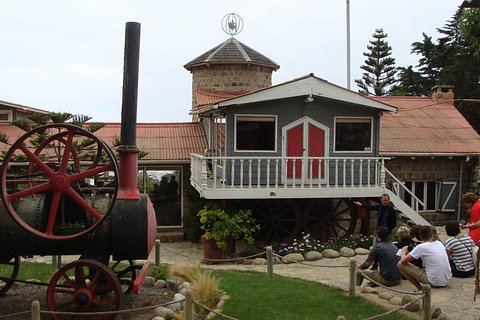 Private Tour Isla Negra, Pomaire and Coastal Resorts Tour from Santiago
Free cancellationPrivate
(opens in a new tab)
-
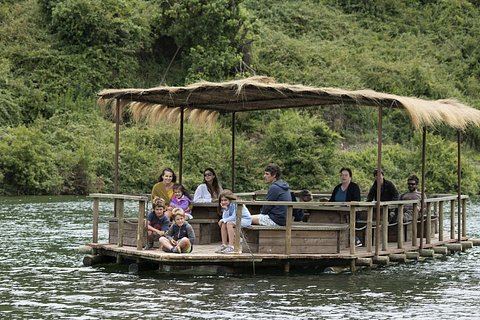 Tour to Parque Tricao + Aviario and Pomaire full day from Santiago
Free cancellationPrivate
(opens in a new tab)
-
 Pomaire and Black Island Tour
Free cancellation
(opens in a new tab)
Affiliate link Viator · If you book through this link, we may earn a commission at no extra cost to you.
Affiliate link
Plan your trip
- Car rental in SantiagoQEEQ (opens in a new tab)
If you book through this link, we may earn a commission at no extra cost to you.