
Written by  Maria Torres · Updated 2026-11-25
- Category
- Day Trips from Santiago
- Area
- Outside Santiago
Valparaíso is Chile's main historic port, about 121 km by road from Plaza de Armas, and its historic quarter was declared a UNESCO World Heritage Site in 2003. In the 19th century it was a major stopover for ships using the Straits of Magellan, and British merchants settled Cerro Alegre and Cerro Concepción, whose lanes still hold their churches and houses. The city's funiculars, or ascensores, began with the Concepción lift in 1883, and Pablo Neruda's house La Sebastiana overlooks the bay. Buses leave frequently from Santiago's terminals. Spend a full day walking the hills, riding a funicular and watching the port.
Quick facts
- Distance from Santiago
- about 121 km by road
Sources · facts checked on 2026-11-16
- OSRM route Plaza de Armas – Plaza Sotomayor, Valparaíso
- Valparaíso – Wikipedia (en)
- Valparaíso – Wikipedia (es)
- Ascensores de Valparaíso – Wikipedia (es)
- Ascensor Concepción – Wikipedia (es)
- Palacio Baburizza – Wikipedia (es)
- Fundación Pablo Neruda – Casa Museo La Sebastiana
- La Sebastiana – Wikipedia (es)
What Valparaíso is and why it makes a day trip
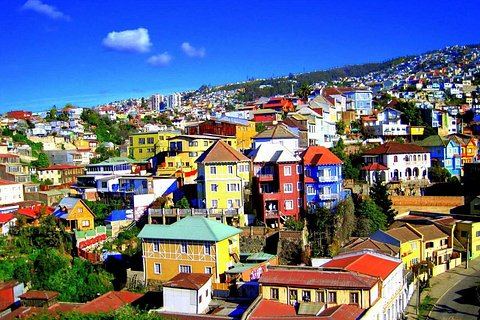
Valparaíso is Chile's historic port on the Pacific, about 121 km by road north-west of Plaza de Armas. The city is split between the Plan, a narrow strip of flat land between the bay and the hills that holds the port, banks and government offices, and the cerros, the steep residential hills where most people live. Its historic quarter, built around the old port and the hills behind it, was inscribed on the UNESCO World Heritage List in 2003.
Since 1990 it has also been the seat of Chile's National Congress. For a visitor from Santiago, a day here usually means riding at least one of the funiculars (ascensores), walking the lanes and lookouts of Cerro Alegre and Cerro Concepción, visiting Pablo Neruda's house La Sebastiana, and looking down on the working port.
History: from colonial anchorage to Pacific hub
Juan de Saavedra gave the bay its name in September 1536, after his hometown in Spain, and on September 3, 1544, Pedro de Valdivia designated it as the port of Santiago. After independence and the opening of Chile to foreign trade, Valparaíso became the main stopover for ships rounding South America through the Straits of Magellan and Cape Horn, and it supplied the California gold rush of 1848 to 1858.
Immigrants arrived mainly from Britain, Germany, France, Switzerland and Italy, and each community built its own churches and schools. A British community prospered here from the 1820s to the 1920s. By the late 19th century the population passed 160,000.
Two blows ended the boom. The earthquake of August 16, 1906, killed about 3,000 people and injured more than 20,000; rebuilding widened streets and created the area around Plaza O'Higgins. The opening of the Panama Canal in 1914 then took away much of the shipping that had depended on the Strait of Magellan route. Since about 2000, artists and visitors have brought new life to the hillside districts.
The funiculars (ascensores)
Because the hills are so steep, Valparaíso built about 30 funiculars from 1883 onward. Sixteen still exist, and all sixteen are protected as Historic Monuments, most of them since 1998. Most rides take no more than a minute. As of October 2025 only seven were running for the public, so check which ones are open on the day you go.
The oldest is the Ascensor Concepción, opened on December 1, 1883. It climbs from Calle Esmeralda, opposite the Reloj Turri clock tower, to Paseo Gervasoni on Cerro Concepción. It started with two wooden cars moved by a water counterweight powered by a steam boiler; the system was later converted to electricity and the cars were replaced with metal ones.
Two others serve the same hills: El Peral (1901) rises from Plaza de Justicia to Paseo Yugoslavo on Cerro Alegre, and Reina Victoria (1903) runs from Calle Elías to Paseo Dimalow, also on Cerro Alegre. The other lifts operating in late 2025 were Cordillera (1887), Barón (1909), Espíritu Santo (1911) and San Agustín (1914). Polanco, unusual because it is a true vertical elevator, has been closed for repairs since 2024.
Cerro Alegre and Cerro Concepción
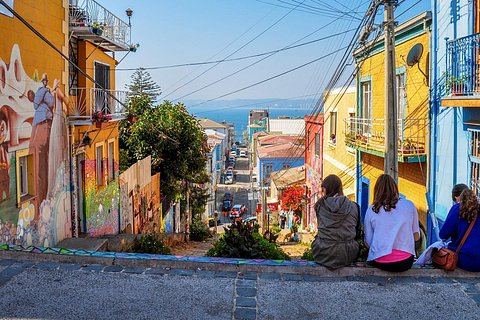
The two oldest residential hills sit side by side above the Plan and are the core of a visit. Their lanes and stairways connect a string of promenades (paseos) with views over the bay: Gervasoni and Atkinson on Cerro Concepción, and Yugoslavo and Dimalow on Cerro Alegre. The houses left by 19th-century British and German residents, along with their churches, give the hills their character.
On Paseo Yugoslavo, at the top of the El Peral lift, stands the Palacio Baburizza. It was built in 1916 for the Italian-born Zanelli family to designs by the Italian architects Arnaldo Barison and Renato Schiavon, and takes its name from its second owner, the Croatian businessman Pascual Baburizza, who bought it in 1925. The city bought the mansion in 1971 for the Municipal Museum of Fine Arts, and it was declared a Historic Monument in 1979.
La Sebastiana and the Open Air Museum on Cerro Bellavista
La Sebastiana, at Ricardo de Ferrari 692 on Cerro Bellavista, is one of Pablo Neruda's three houses and is run as a house museum by the Fundación Pablo Neruda, like La Chascona in Santiago and Isla Negra (Casa Museo Isla Negra) on the coast. In 1959 Neruda found the unfinished shell of a tall house begun by the Spaniard Sebastián Collado, who had died in 1949. He bought it jointly with the sculptor Marie Martner and her husband, Dr. Francisco Velasco: they kept the basement, patio and first two floors, and Neruda took the third and fourth floors and the tower. He opened it on September 18, 1961, with a party, and named it after its first builder.
Inside are old maps, seascapes, a portrait of Lord Cochrane, a painting of José Miguel Carrera shortly before his execution, music boxes and a carved wooden carousel horse. Neruda watched the New Year's fireworks from here, the last time at the turn of 1973. Looted after the 1973 coup, it was restored in 1991 and opened as a museum that December; it was declared a Historic Monument in December 2011.
Below the house, the slopes of Cerro Bellavista hold the Museo a Cielo Abierto (Open Air Museum), a route of 20 murals painted on house walls and retaining walls, inaugurated in 1992, with works by artists including Roberto Matta and Mario Carreño.
Opening hours and tickets for La Sebastiana
In November 2026 the Fundación Pablo Neruda listed the same hours for all three of its houses: Tuesday to Sunday, 10:00 a.m. to 6:00 p.m. from March to December, and 10:00 a.m. to 7:00 p.m. in January and February. The closing time is the last entry, entry is first come, first served without a reservation, and pets are not allowed. The 2026 general admission was CLP 11,000, with a reduced CLP 4,500 ticket for students and for residents of Chile over 60 with ID. Audio guides come in six languages, English included. Check before you go.
How to get to Valparaíso from Santiago
Intercity buses are the usual way. Terminal Alameda in Estación Central, owned by Turbus and Pullman Bus and also used by Cóndor, JAC and Pullman Bus Costa Central, has a direct underground connection to Universidad de Santiago station on Metro Line 1. Departure points, schedules and fares vary by company, so check the operator's site before you travel.
By car, the route from Plaza de Armas follows the Ruta 68 highway through the Lo Prado and Zapata tunnels, with electronic free-flow tolls. The road gets heavy traffic on summer weekends, long weekends and around New Year.
Once in Valparaíso, the Tren Limache-Puerto commuter train, run by EFE Valparaíso, starts at Puerto station in the Barrio Puerto and follows the shore to Viña del Mar, Quilpué, Villa Alemana and Limache.
Tips for planning the day
Ride Concepción or El Peral up, follow the promenades across both hills and walk down by the stairways. La Sebastiana is on a different hill, Cerro Bellavista, and closes on Mondays.
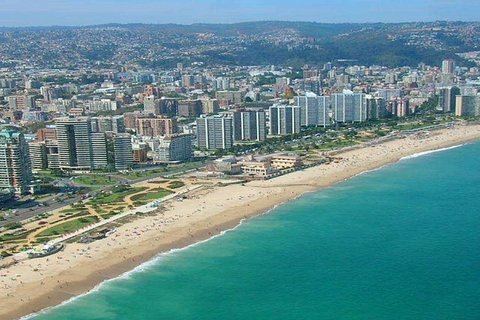
Viña del Mar is next door, linked by the coastal train, so it fits into the same trip, and the Casablanca Valley (Valle de Casablanca) lies on Ruta 68 between Santiago and the coast. The New Year's fireworks over the bay draw huge crowds every year.
What to see in Valparaíso
The main stops for a first day, with the hill or district where each one is.
Ascensor Concepción
Where Calle Esmeralda to Paseo Gervasoni
The city's first funicular, opened December 1, 1883
Ascensor El Peral
Where Plaza de Justicia to Paseo Yugoslavo
Funicular of 1901 up to Cerro Alegre
Ascensor Reina Victoria
Where Calle Elías to Paseo Dimalow
Funicular of 1903 on Cerro Alegre
Palacio Baburizza
Where Paseo Yugoslavo, Cerro Alegre
1916 mansion, home of the Municipal Museum of Fine Arts
La Sebastiana
Where Ricardo de Ferrari 692, Cerro Bellavista
Neruda's house museum, opened as his home in 1961
Museo a Cielo Abierto
Where Cerro Bellavista
Route of 20 murals inaugurated in 1992
Plaza Sotomayor
Where Barrio Puerto, the Plan
Square in the oldest district, faced by the Chilean Navy building
Cemeteries of Cerro Panteón
Where Cerro Panteón
Cemetery No. 1 and the Dissidents Cemetery for Protestants
Funicular operation changes often; as of October 2025 seven of the sixteen surviving lifts were open to the public.
Frequently asked questions
How far is Valparaíso from Santiago?
About 121 km by road from Plaza de Armas, mostly on the Ruta 68 highway. Without traffic the drive takes roughly an hour and a half.
How do I get from Santiago to Valparaíso by bus?
Intercity buses leave from Santiago's terminals, including Terminal Alameda, which connects underground with Universidad de Santiago station on Metro Line 1. Check schedules and the departure terminal on the bus company's site.
Are the Valparaíso funiculars running?
Of the 16 surviving ascensores, seven were open to the public as of October 2025: Concepción, Cordillera, El Peral, Reina Victoria, Barón, Espíritu Santo and San Agustín. Polanco has been under repair since 2024.
What are the opening hours of La Sebastiana?
In November 2026 it opened Tuesday to Sunday from 10:00 a.m. to 6:00 p.m. (7:00 p.m. in January and February), with the closing time as last entry. Entry is walk-in; check before you go.
Can I visit Valparaíso and Viña del Mar in one day?
Yes. The two cities are side by side and linked by the Tren Limache-Puerto commuter train along the shore, as well as by local buses.
Why is Valparaíso a UNESCO World Heritage Site?
Its historic quarter around the old port and the hills behind it was inscribed in 2003 for its hillside urban layout and architecture from its era as a Pacific trading port.
Popular tours that include Valparaíso
-
 Valparaiso Port and Viña del Mar with Casablanca Wine Tasting
Free cancellation
(opens in a new tab)
-
 Tour to Valparaíso, Viña del Mar, Pablo Neruda Museum and Vineyard
Free cancellation
(opens in a new tab)
-
 Viña Del Mar-Valparaiso -Casablanca -Reñaca-Oceanic Rock-Concon
Free cancellation
(opens in a new tab)
Affiliate link Viator · If you book through this link, we may earn a commission at no extra cost to you.
Affiliate link
Plan your trip
- Private transfer from Santiago to ValparaísoKiwitaxi (opens in a new tab)
- Car rental in SantiagoQEEQ (opens in a new tab)
If you book through this link, we may earn a commission at no extra cost to you.